Context and debate After 1945

What the two journeys left behind

After 1945

Hiroshima and Nagasaki remain the only times nuclear weapons have been used in war. But the bomb did not stay with the country that built it. This page follows what came after: a broken promise to Britain, the arms race, the tests and the protest they sparked, the treaties, and the weapons the world holds today.

Year by year

  1. 1946

    Congress closes the door

    The McMahon Act, signed on 1 August, ends the sharing of atomic information with every other country, Britain included.Sources: 1 13 14

  2. 1949

    The Soviet bomb

    The Soviet Union tests its first atomic bomb at Semipalatinsk on 29 August. Truman announces it on 23 September.Sources: 3 15

  3. 1952

    Britain’s bomb, and the first H-bomb

    Britain tests its own bomb in the Monte Bello Islands off Australia on 3 October. On 1 November, local time, the United States explodes Mike, the first thermonuclear device, at Enewetak.Sources: 5 6 16 17

  4. 1954

    Castle Bravo

    A test at Bikini on 1 March yields about 15 megatons, far more than expected. Fallout lands on the Japanese fishing boat Daigo Fukuryu Maru and its 23 crew.Sources: 7 8

  5. 1955

    Hiroshima hosts the world

    The first World Conference against Atomic and Hydrogen Bombs opens in Hiroshima on 6 August.Sources: 18

  6. 1956

    The survivors organise

    Nihon Hidankyo, the national organisation of hibakusha, is founded in Nagasaki on 10 August.Sources: 19 20

  7. 1958

    The partnership restored

    Britain and the United States sign the Mutual Defence Agreement on 3 July.Sources: 9

  8. 1962

    The closest call

    In October the Cuban missile crisis brings the United States and the Soviet Union closest to nuclear war.Sources: 21

  9. 1963

    No more tests in the open air

    The Partial Test Ban Treaty, in force from 10 October, bans tests in the atmosphere, in space and under water.Sources: 22 23

  10. 1967

    The American peak

    The US stockpile reaches its largest, 31,255 warheads.Sources: 24

  11. 1970

    The Non-Proliferation Treaty

    The treaty comes into force on 5 March.Sources: 25

  12. 1986

    The world’s peak

    The world holds about 70,300 nuclear warheads, counting those retired but not yet dismantled.Sources: 12

  13. 1996

    A test ban signed, not in force

    The Comprehensive Nuclear-Test-Ban Treaty opens for signature on 24 September. It is still not in force.Sources: 26

  14. 2021

    A ban on the weapons themselves

    The Treaty on the Prohibition of Nuclear Weapons comes into force on 22 January. No nuclear-armed state has joined, and nor has Japan.Sources: 27 28

  15. 2024

    The survivors’ prize

    Nihon Hidankyo is awarded the Nobel Peace Prize.Sources: 20

Britain and America: a promise broken

The bomb was a joint project. Britain’s MAUD report of 1941 gave the Americans a concrete plan, and a British Mission of 19 scientists worked at Los Alamos. William Penney, one of them, helped calculate the height at which the bombs should burst over Japan. Sources: 29 30 31 32

In return, Roosevelt promised Churchill that the partnership would go on after the war. It did not. These are the papers that show how. Sources: 33

Britain and the bomb tells Britain’s whole part, from the Birmingham memorandum of 1940 to Polaris.
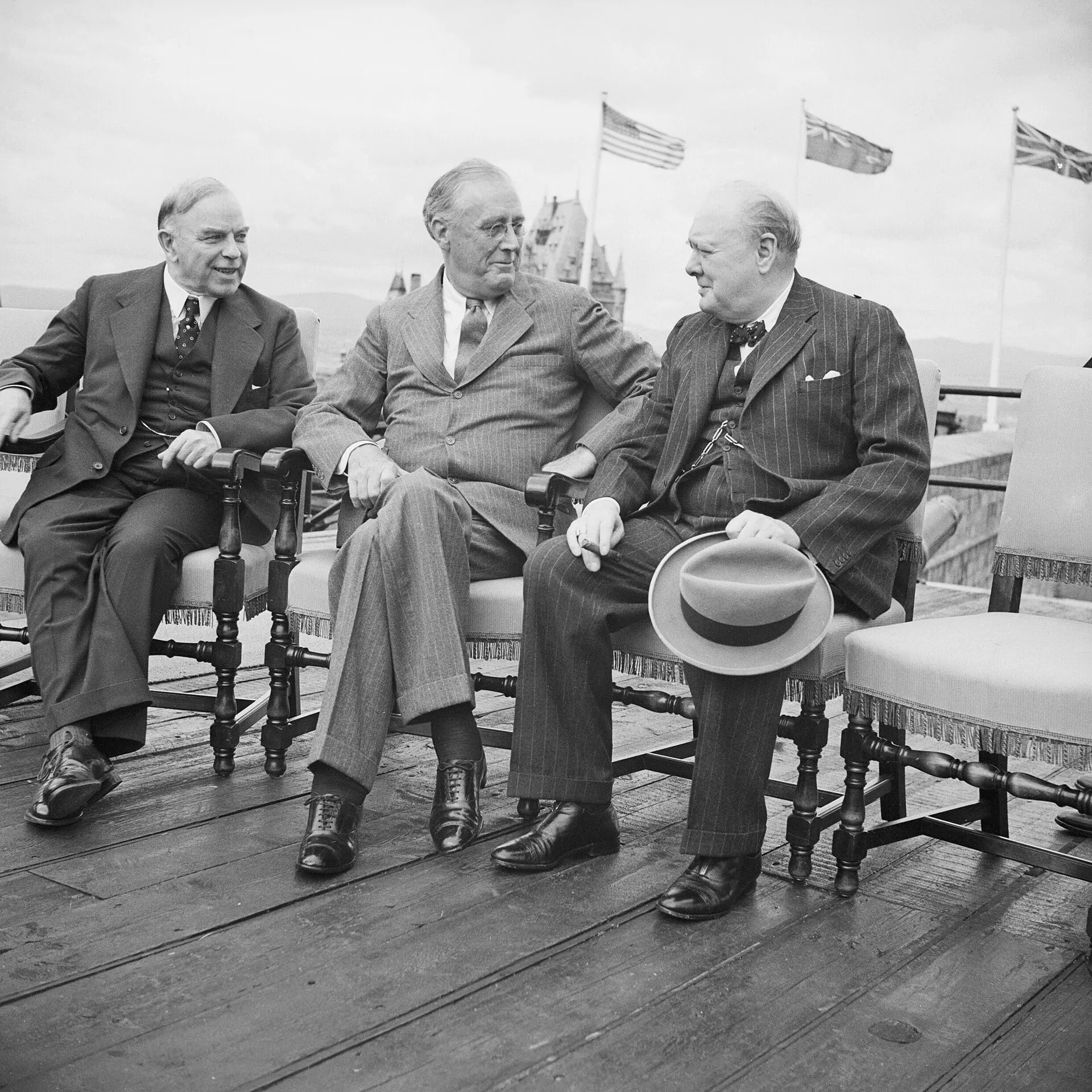
Mackenzie King, Franklin Roosevelt and Winston Churchill seated together on a terrace at Quebec.
Mackenzie King, Franklin Roosevelt and Winston Churchill at the Quebec Conference, 18 August 1943, the day before the atomic agreement was signed. Captain Horton, War Office official photographer (Imperial War Museum H 32129), Public domain (UK government, copyright expired), source
  1. Date
    19 August 1943
    From
    Franklin Roosevelt and Winston Churchill
    Held at
    US National Archives (printed in FRUS) and The National Archives, Kew

    The Quebec Agreement

    we will never use this agency against each other.

    The two leaders agreed to pool “all available British and American brains and resources”, with “full and effective interchange of information and ideas” in research. Britain gave up any claim to post-war industrial advantage beyond what the President thought “fair and just”. The agreement stayed secret until Churchill published it in 1954.Sources: 34 35

  2. Date
    18 September 1944
    From
    Franklin Roosevelt and Winston Churchill, initialled
    Held at
    Franklin D. Roosevelt Library, Hyde Park

    The promise at Hyde Park

    Full collaboration between the United States and the British Government in developing Tube Alloys for military and commercial purposes should continue after the defeat of Japan unless and until terminated by joint agreement.

    After Roosevelt died, American officials could not find their copy. Churchill sent a photograph of the British one in July 1945. The American copy turned up years later in the files of Roosevelt’s naval aide, apparently filed as naval supplies.Sources: 30 33 36

  3. Date
    16 November 1945
    From
    Harry Truman, Clement Attlee and Mackenzie King
    Held at
    US National Archives (printed in FRUS)

    Truman renews the promise

    We desire that there should be full and effective cooperation in the field of atomic energy between the United States, the United Kingdom and Canada.

    The same day General Groves and Sir John Anderson drafted the terms. They limited “full and effective cooperation” to basic research. Building and running plants was left to arrangements to be agreed case by case.Sources: 37 38

  4. Date
    16 and 20 April 1946
    From
    Attlee to Truman, and Truman’s reply
    Held at
    US National Archives (printed in FRUS)

    Two readings of the same words

    no one at any time informed me that the memorandum was proposed with the intention of having the United States obligate itself to furnish the engineering and operation assistance necessary for the construction of another atomic energy plant. Had that been done I would not have signed the memorandum.

    Attlee wrote that “full and effective cooperation” “cannot mean less than full interchange of information and a fair division of the material.” Truman answered that the words were “very general”, and that building a British plant would undercut the hope of international control through the United Nations.Sources: 30 39 40

    How it is read

    • The official US history calls the American position “manifestly unfair”, but says the hope of international control “played the major part” in Truman’s thinking.
  5. Date
    1 August 1946
    From
    The US Congress, signed by President Truman
    Held at
    US Statutes at Large, 60 Stat. 755

    The McMahon Act

    there shall be no exchange of information with other nations with respect to the use of atomic energy for industrial purposes

    The Atomic Energy Act did not name Britain, but its controls on “restricted data” ended the exchange with every country, Britain included. British scientists at Los Alamos lost access even to their own reports. The last of them left in April 1947.Sources: 1 2 13 31

  6. Date
    1952, read to the Commons on 5 April 1954
    From
    Senator Brien McMahon, quoted by Churchill
    Held at
    Hansard, House of Commons, 5 April 1954

    The senator who did not know

    the nature of the agreements which made this contribution possible was not disclosed to me and my colleagues on the Senate Special Atomic Energy Committee at the time we framed the law in 1946.

    In the same debate Churchill blamed the Labour government for not pressing the agreements. Attlee replied: “We did not abandon anything.” The United States administration, he said, had been “prevented by the action of the Senate”.Sources: 35 41

  7. Date
    3 July 1958
    From
    The governments of the United Kingdom and the United States
    Held at
    The National Archives and GOV.UK Treaty Series

    The partnership restored

    the concept of national self-sufficiency is now out of date.

    After Sputnik, Eisenhower and Macmillan declared that interdependence in October 1957. Congress then allowed sharing with a nation that “has made substantial progress in the development of atomic weapons”. The agreement was signed on 3 July 1958. Since 14 November 2024 it has had no end date.Sources: 9 42 43 44 45

The American side had its reasons. The official US history names wartime distrust, security, a Congress set on protecting the secret, and the arrest in 1946 of Alan Nunn May, a British scientist who had passed information to the Soviet Union. Sources: 30 46

Above all, it says, Truman did not want a close tie with Britain to spoil the hope of international control. Sources: 30 40

Britain goes alone

On 8 January 1947 a small committee of ministers decided that Britain would build its own bomb, in secret. Parliament was told in May 1948. Sources: 5 13 47

The Foreign Secretary, Ernest Bevin, is remembered as saying “We’ve got to have the bloody Union Jack on top of it”, but that comes from a recollection in 1982; the minutes of the meeting record his views “in a more measured way”. Sources: 13

Klaus Fuchs, a member of the British Mission at Los Alamos, had been passing atomic secrets to the Soviet Union since 1941. He was arrested in Britain on 2 February 1950 and sentenced to 14 years. His arrest halted the talks that were trying to restore cooperation. Sources: 48 49

Britain tested its first bomb, Operation Hurricane, on 3 October 1952. It was exploded inside the hull of the frigate HMS Plym in the Monte Bello Islands, off Western Australia, and yielded 25 kilotons. William Penney led the test. Sources: 5 6 10 14
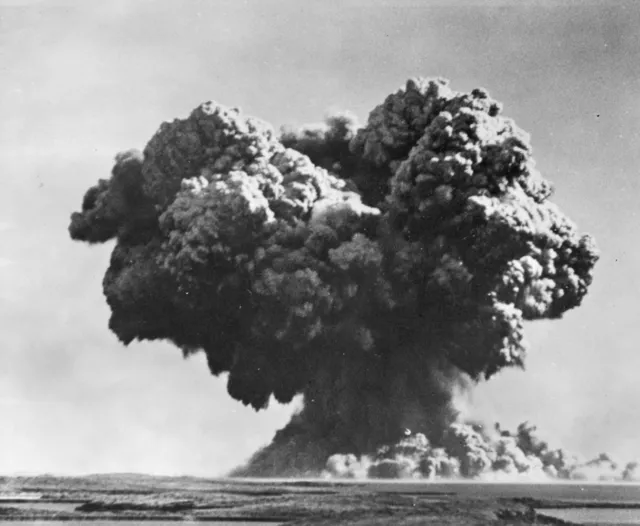
A black and white photograph of a dark, billowing cloud rising from the sea after Britain’s first atomic test.
Operation Hurricane, the Monte Bello Islands, 3 October 1952. Australian War Memorial, Naval Historical Collection (P00444.045), Public domain (Australian government, copyright expired), source

Britain made 12 atomic tests in Australia between 1952 and 1957. An Australian Royal Commission reported in 1985 that the Monte Bello Islands “were not an appropriate place for atomic tests”, and that the Hurricane trial failed “to consider the distinctive lifestyles of Aboriginal people”. Sources: 6 50

The Soviet bomb

The Soviet Union tested its first bomb, RDS-1, at Semipalatinsk on 29 August 1949. It was a plutonium implosion bomb, closely based on the American design that Fuchs and others had passed to Moscow. The Atomic Heritage Foundation estimates that spying saved the Soviet programme between six months and two years. Sources: 3 51

An American weather aircraft, a WB-29, picked up its radioactive debris over the Pacific on 3 September. On 23 September Truman told the world: “We have evidence that within recent weeks an atomic explosion occurred in the U.S.S.R.” Sources: 15 52

The hydrogen bomb and the Lucky Dragon

In January 1950 Truman ordered work on the hydrogen bomb. The first American thermonuclear device, Mike, weighed 82 tons and yielded 10.4 megatons at Enewetak on 1 November 1952, local time. The Soviet Union’s first megaton-range hydrogen bomb followed on 22 November 1955. Sources: 16 53 54 55
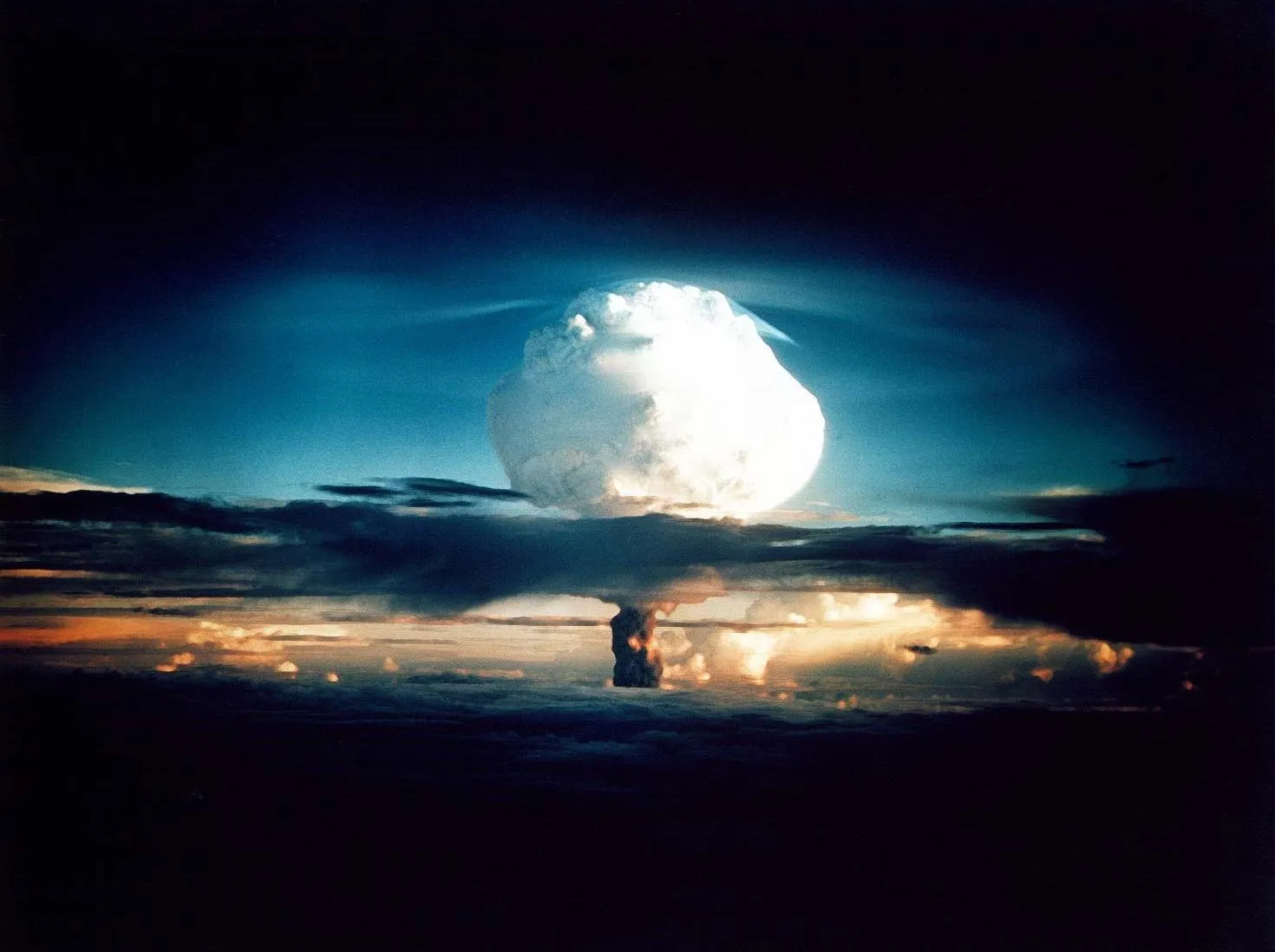
A huge glowing fireball rising above a line of cloud over the ocean at dawn.
Mike, the first thermonuclear test, Enewetak Atoll, 1 November 1952. US National Nuclear Security Administration, Public domain (US government), source

On 1 March 1954 the American test Castle Bravo, at Bikini, yielded about 15 megatons, nearly three times what was expected. Fallout fell on islands far downwind and on the Japanese tuna boat Daigo Fukuryu Maru. All 23 of its crew were exposed. Sources: 7 8

The boat’s chief radio operator, Aikichi Kuboyama, died on 23 September 1954. The cause of his death is disputed; the US National Security Archive describes it as liver ailments “possibly aggravated” by his exposure. Sources: 7 56
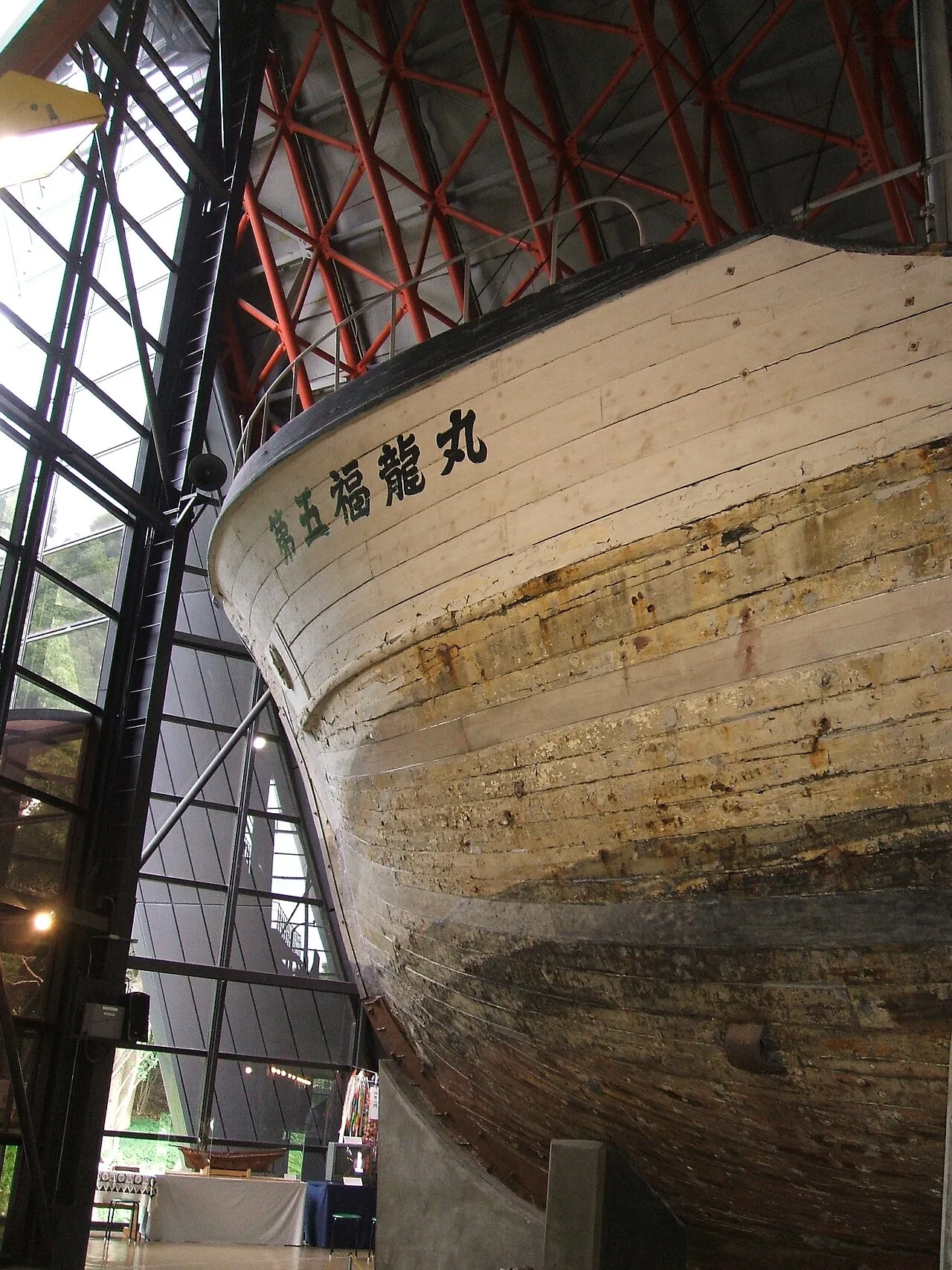
The wooden bow of the fishing boat Daigo Fukuryu Maru, with its name painted in Japanese, inside a tall glass and steel hall.
The Daigo Fukuryu Maru, preserved in its exhibition hall in Tokyo. carpkazu, Public domain (released by the photographer), source

In Japan a petition against the bombs gathered more than 20 million signatures by the end of 1954. Sources: 57

It led to the first World Conference against Atomic and Hydrogen Bombs, in Hiroshima in August 1955, and to the founding of Nihon Hidankyo in Nagasaki in August 1956. Its founders included victims of the Pacific tests as well as the survivors of Hiroshima and Nagasaki. Sources: 18 19 20 57

The B-29 after the war

The 509th Composite Group left Tinian on 17 October 1945 and went home to Roswell, New Mexico. It later became part of the new Strategic Air Command. Sources: 58 59

B-29s went back to war over Korea in 1950. Soviet-built MiG-15 jet fighters proved deadly to them: on one day in October 1951 MiGs knocked out six of nine B-29s, and from that November they bombed only at night. Strategic Air Command retired its last B-29 bomber on 4 November 1954. Sources: 60 61 62
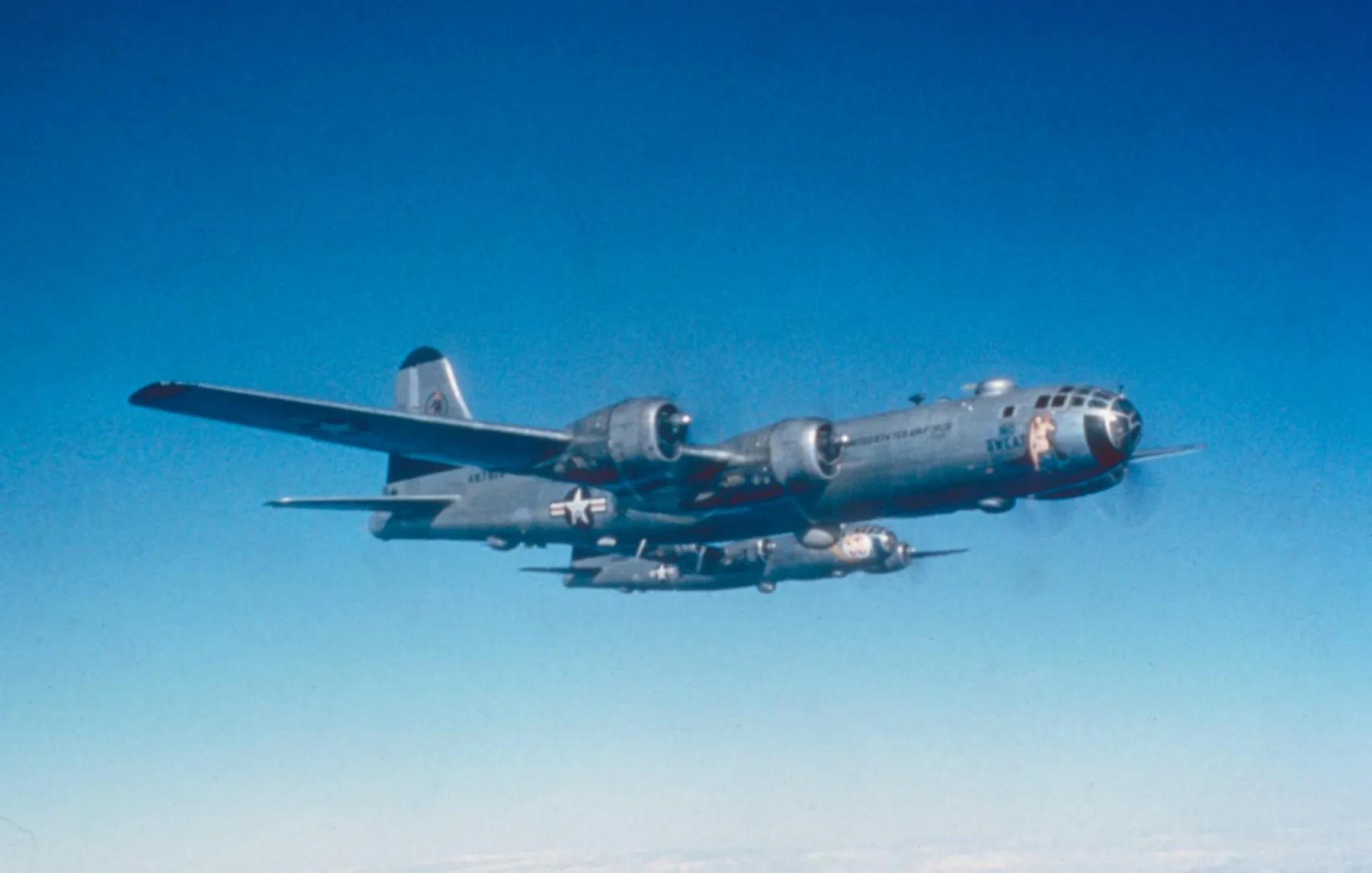
Two silver B-29 bombers flying in formation against a clear blue sky.
B-29s of the 19th Bomb Group on a mission over Korea, 1950. US Air Force, Public domain (US government), source

The Soviet Union built its own B-29. Three American B-29s had landed in the Soviet Far East in 1944 and were interned. Stalin ordered an exact copy. The result, the Tu-4, first flew in May 1947, and on 18 October 1951 a Tu-4 dropped a Soviet atomic bomb. Sources: 63
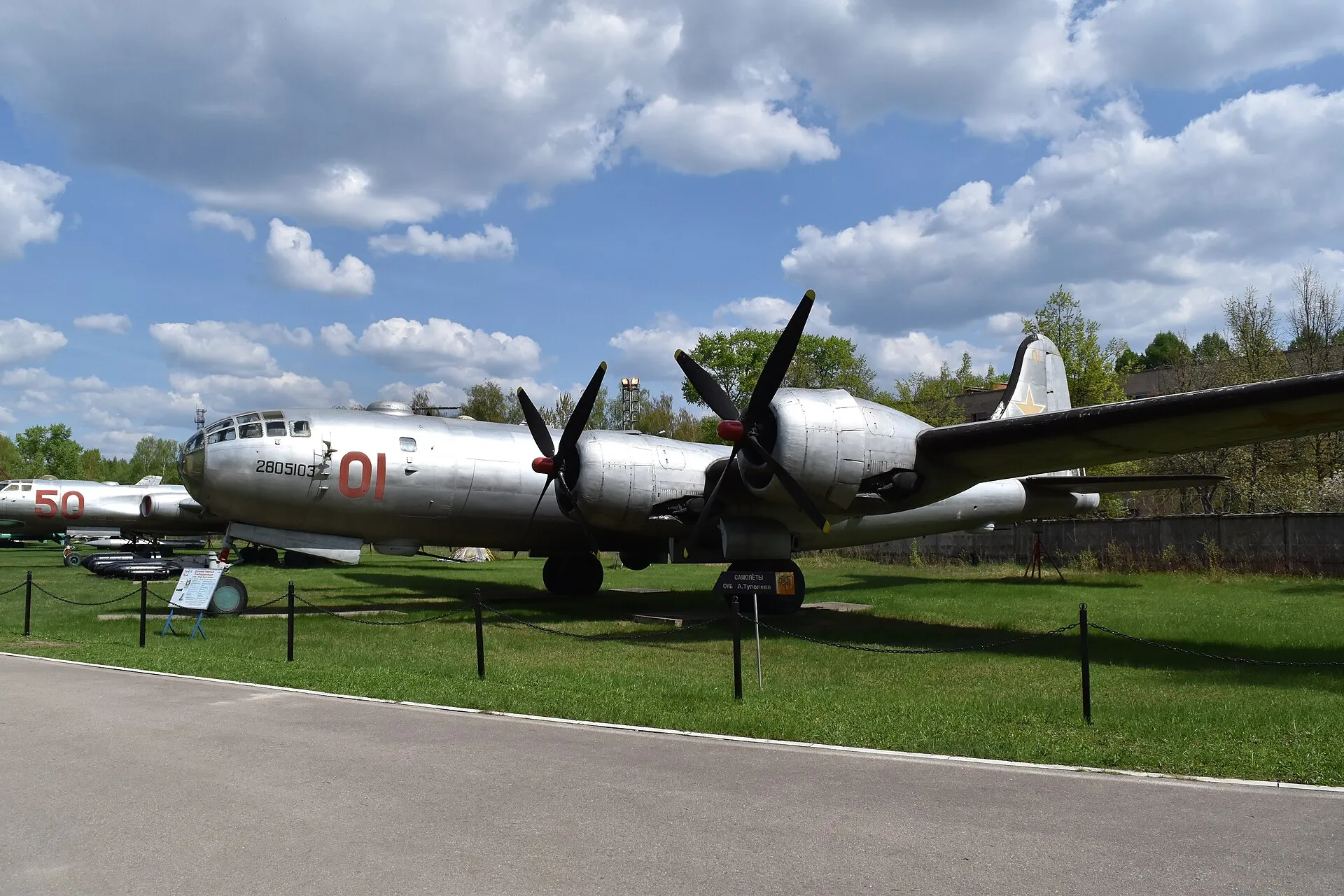
A silver Tu-4 bomber, a copy of the B-29, parked on grass at an open-air aircraft museum.
A Tu-4, the Soviet copy of the B-29, at the Central Air Force Museum, Monino. Toshonenov, CC BY-SA 4.0, source

The arms race in numbers

Figures for warheads change. Each is given with the year it was true. Sources: 12

Warheads When How many
US stockpile at its peak Sources: 24 1967 31,255
Soviet stockpile at its peak Sources: 64 about 1986 about 40,000
World inventory at its peak, including retired warheads Sources: 12 1986 about 70,300
World inventory today Sources: 11 12 January 2026 about 12,187

More than 2,000 nuclear tests were carried out between 1945 and 1996: 1,032 by the United States, 715 by the Soviet Union, 210 by France, 45 by Britain, 45 by China and one by India. Ten more have followed since 1996, by India, Pakistan and North Korea. Sources: 4

The treaties

Treaty Opened In force Parties, October 2026
Partial Test Ban Treaty Sources: 22 1963 10 October 1963 125
Non-Proliferation Treaty Sources: 25 1 July 1968 5 March 1970 191
Comprehensive Nuclear-Test-Ban Treaty Sources: 26 24 September 1996 Not in force 179
Treaty on the Prohibition of Nuclear Weapons Sources: 27 20 September 2017 22 January 2021 75

The test ban treaty cannot come into force until all 44 states named in it have ratified. China, Egypt, Iran, Israel and the United States have signed but not ratified; India, Pakistan and North Korea have not signed; Russia withdrew its ratification in 2023. Sources: 26 65

Japan has not joined the prohibition treaty. Its government says no nuclear-armed state is likely to join, given the treaty’s “incompatibility with nuclear deterrence”, and prefers to work through the Non-Proliferation Treaty. Sources: 28 66

Today

Nine countries hold nuclear weapons: the United States, Russia, Britain, France, China, India, Pakistan, North Korea and Israel. In January 2026 they held an estimated 12,187 warheads, about 4,012 of them deployed with missiles and aircraft. Sources: 11 12

The United States and Russia hold about 86 per cent of them. Sources: 12

No nuclear weapon has been used in war since Nagasaki. Sources: 16 20 67

Sources for this page67
  1. US Government Publishing Office, Atomic Energy Act of 1946 (60 Stat. 755). Checked 13 October 2026.
  2. US Department of Energy, Office of Scientific and Technical Information, Civilian Control of Atomic Energy. Checked 13 October 2026.
  3. Atomic Heritage Foundation, Soviet Atomic Program, 1946. Checked 13 October 2026.
  4. United Nations, International Day against Nuclear Tests: history. Checked 13 October 2026.
  5. Ministry of Defence, GOV.UK, Key events in the UK atmospheric nuclear test programme. Checked 13 October 2026.
  6. Australian Radiation Protection and Nuclear Safety Agency, British nuclear weapons testing in Australia. Checked 13 October 2026.
  7. William Burr (ed.), National Security Archive, 29 February 2024, Castle BRAVO at 70: The Worst Nuclear Test in U.S. History (Briefing Book 853). Checked 13 October 2026.
  8. Daigo Fukuryu Maru Exhibition Hall, Tokyo, About the Daigo Fukuryu Maru. Checked 13 October 2026.
  9. Foreign, Commonwealth and Development Office, GOV.UK, Amendment to the US and UK Agreement for Cooperation on the Uses of Atomic Energy for Mutual Defense Purposes (Treaty Series No. 41, 2026). Checked 13 October 2026.
  10. AWE, Our history. Checked 13 October 2026.
  11. Stockholm International Peace Research Institute, SIPRI Yearbook 2026 press release, 8 June 2026. Checked 13 October 2026.
  12. Hans M. Kristensen, Matt Korda and others, Federation of American Scientists, Status of World Nuclear Forces, 2026. Checked 13 October 2026.
  13. Gill Bennett, FCDO Historians, GOV.UK, 7 January 2022, What's the Context? The decision to build a British atomic bomb, 8 January 1947. Checked 13 October 2026.
  14. US Department of Energy, Office of Scientific and Technical Information, Proliferation. Checked 13 October 2026.
  15. The American Presidency Project, UC Santa Barbara, Statement by the President announcing the first atomic explosion in the USSR, 23 September 1949. Checked 13 October 2026.
  16. US Department of Energy, NNSA Nevada Field Office, 2015, United States Nuclear Tests, July 1945 through September 1992 (DOE/NV-209 Rev 16). Checked 13 October 2026.
  17. Atomic Heritage Foundation, Hydrogen Bomb, 1950. Checked 13 October 2026.
  18. Kyosuke Mizukawa, Chugoku Shimbun, 16 March 2025, August 6, 1955: first World Conference against Atomic and Hydrogen Bombs is held. Checked 13 October 2026.
  19. Michio Shimotaka and Hiromi Morita, Chugoku Shimbun, 1 December 2024, Nihon Hidankyo's path to the Nobel Peace Prize, part 1. Checked 13 October 2026.
  20. The Norwegian Nobel Committee, The Nobel Peace Prize 2024, press release. Checked 11 October 2026.
  21. US Department of State, Office of the Historian, The Cuban Missile Crisis, October 1962. Checked 13 October 2026.
  22. UN Office for Disarmament Affairs, treaties database, Partial Test Ban Treaty. Checked 13 October 2026.
  23. US Department of State, Office of the Historian, The Limited Test Ban Treaty, 1963. Checked 13 October 2026.
  24. US Department of Energy, NNSA, Transparency in the U.S. Nuclear Weapons Stockpile (fact sheet, October 2021). Checked 13 October 2026.
  25. UN Office for Disarmament Affairs, treaties database, Treaty on the Non-Proliferation of Nuclear Weapons. Checked 13 October 2026.
  26. UN Office for Disarmament Affairs, treaties database, Comprehensive Nuclear-Test-Ban Treaty. Checked 13 October 2026.
  27. UN Office for Disarmament Affairs, treaties database, Treaty on the Prohibition of Nuclear Weapons. Checked 13 October 2026.
  28. UN Office for Disarmament Affairs, treaties database, Treaty on the Prohibition of Nuclear Weapons: participants. Checked 13 October 2026.
  29. US Department of Energy, Office of Scientific and Technical Information, The MAUD Report, 1941. Checked 11 October 2026.
  30. Richard G. Hewlett and Oscar E. Anderson Jr., Pennsylvania State University Press, 1962 (US Department of Energy), The New World, 1939/1946 (A History of the United States Atomic Energy Commission, vol. I). Checked 13 October 2026.
  31. Angie Piccolo, Los Alamos National Laboratory, The Vault, Los Alamos and the British Mission. Checked 13 October 2026.
  32. Atomic Heritage Foundation, British Nuclear Program. Checked 13 October 2026.
  33. US Department of State, Office of the Historian, Aide-Memoire of Conversation Between the President and the Prime Minister at Hyde Park, 18 September 1944 (FRUS, Conference at Quebec, 1944, document 299). Checked 13 October 2026.
  34. US Department of State, Office of the Historian, Agreement Relating to Atomic Energy (the Quebec Agreement), 19 August 1943 (FRUS, Conferences at Washington and Quebec, 1943, document 521). Checked 13 October 2026.
  35. UK Parliament, Hansard, Hydrogen Bomb, House of Commons debate, 5 April 1954. Checked 13 October 2026.
  36. US Department of State, Office of the Historian, Churchill to Stimson, 18 July 1945, with the photostat of the Hyde Park aide-memoire (FRUS, Conference of Berlin, vol. II, document 1306). Checked 13 October 2026.
  37. US Department of State, Office of the Historian, Memorandum by Truman, Attlee and Mackenzie King, 16 November 1945 (FRUS 1945, vol. II, document 28). Checked 13 October 2026.
  38. US Department of State, Office of the Historian, Memorandum by Groves and Anderson, 16 November 1945 (FRUS 1945, vol. II, document 29). Checked 13 October 2026.
  39. US Department of State, Office of the Historian, Attlee to Truman, 16 April 1946 (FRUS 1946, vol. I, document 615). Checked 13 October 2026.
  40. US Department of State, Office of the Historian, Truman to Attlee, 20 April 1946 (FRUS 1946, vol. I, document 619). Checked 13 October 2026.
  41. US Department of State, Office of the Historian, Memorandum by David Lilienthal, April 1947 (FRUS 1947, vol. I, document 411). Checked 13 October 2026.
  42. The American Presidency Project, UC Santa Barbara, Declaration of Common Purpose by the President and the Prime Minister of the United Kingdom, 25 October 1957. Checked 13 October 2026.
  43. US Government Publishing Office, Public Law 85-479, amending the Atomic Energy Act of 1954, 2 July 1958 (72 Stat. 276). Checked 13 October 2026.
  44. National Security Archive, 13 May 2021, The British Bomb and the United States, Part One. Checked 13 October 2026.
  45. UK Parliament, Written question 79348, answered 20 October 2025. Checked 13 October 2026.
  46. The National Archives, KV 2/2209, Alan Nunn May. Checked 13 October 2026.
  47. UK Parliament, Hansard, Armed Forces (Modern Weapons), House of Commons, 12 May 1948. Checked 13 October 2026.
  48. MI5, The Security Service, Klaus Fuchs. Checked 13 October 2026.
  49. FCDO Historians, GOV.UK, 2 March 2020, What's the Context? Sentencing of atomic spy Klaus Fuchs, 1 March 1950. Checked 13 October 2026.
  50. Commonwealth of Australia (archived copy), Royal Commission into British Nuclear Tests in Australia: conclusions and recommendations (1985). Checked 13 October 2026.
  51. Atomic Heritage Foundation, Igor Kurchatov. Checked 13 October 2026.
  52. William Burr (ed.), National Security Archive, 22 September 2009, Detection of the first Soviet nuclear test, September 1949 (Briefing Book 286). Checked 13 October 2026.
  53. The American Presidency Project, UC Santa Barbara, Statement by the President on the hydrogen bomb, 31 January 1950. Checked 13 October 2026.
  54. Los Alamos National Laboratory, National Security Science, 75 years of weapons advances. Checked 13 October 2026.
  55. Atomic Heritage Foundation, Soviet Hydrogen Bomb Program. Checked 13 October 2026.
  56. Atomic Heritage Foundation, Castle Bravo. Checked 13 October 2026.
  57. Masami Nishimoto, Chugoku Shimbun, Hiroshima Peace Media Center, History of Hiroshima: 1945 to 1995, part 18 (the signature drive). Checked 13 October 2026.
  58. Atomic Heritage Foundation, 509th Composite Group. Checked 11 October 2026.
  59. US Air Force, 509 Bomb Wing (ACC) fact sheet. Checked 13 October 2026.
  60. National Museum of the United States Air Force, Boeing B-29 Superfortress. Checked 11 October 2026.
  61. Stephen Joiner, Air & Space Magazine, Smithsonian, December 2013, The Jet that Shocked the West. Checked 13 October 2026.
  62. Air Force Historical Foundation, November 4, 1954. Checked 13 October 2026.
  63. Von Hardesty, Air & Space Magazine, Smithsonian, March 2001, Made in the U.S.S.R.. Checked 13 October 2026.
  64. Alexander Glaser and Malte Gottsche, US Department of Energy, OSTI, Fissile Material Stockpile Declarations and Cooperative Nuclear Archaeology. Checked 13 October 2026.
  65. UN Office for Disarmament Affairs, treaties database, Comprehensive Nuclear-Test-Ban Treaty: participants. Checked 13 October 2026.
  66. Ministry of Foreign Affairs of Japan, Diplomatic Bluebook 2025, chapter 3, section 4. Checked 13 October 2026.
  67. International Committee of the Red Cross, 10 October 2018, Nuclear weapons. Checked 13 October 2026.
Where sources differ6
  • Sources differ on the time of the Hurricane burst: the US Department of Energy history says midnight, a UK photograph caption says 8 a.m. local time.
  • Ivy Mike is dated 31 October 1952 in the official US test list, which uses Greenwich time, and 1 November 1952 by the Atomic Heritage Foundation, which uses local time at Enewetak. Both are the same moment.
  • The US peak is given as 31,255 warheads at the end of fiscal year 1967 (NNSA, 2021). Some scholars give 31,175 in 1966, from an earlier release.
  • Mike's yield is given as 10.4 megatons by Los Alamos and the official US test list, and as 10 megatons by the Atomic Heritage Foundation.
  • Sources give the Daigo Fukuryu Maru's distance from the explosion as 160 kilometres (the Exhibition Hall in Tokyo) or about 80 miles (Atomic Heritage Foundation).
  • Counts of US tests differ by method: the UN gives 1,032; the US Department of Energy counts 1,054, including 28 joint tests with Britain.

Checked against its sources on 13 October 2026.