Four cities on a list
Choosing the targets
Four Japanese cities were named in the order to use the first atomic bomb. A committee of officers and scientists drew up the list in the spring of 1945, the Air Force held the chosen cities back from its fire raids, and the Secretary of War struck off the committee’s first choice, Kyoto. Sources: 1 2 3 4
Japan, not Germany
The first recorded talk of a target came on 5 May 1943. The committee that oversaw the project thought the best use would be on Japanese ships at anchor in Truk, where a bomb that failed to go off would sink in deep water. Sources: 9 10
Japan was preferred to Germany, because the Japanese “would not be so apt to secure knowledge from it as would the Germans.” Sources: 9 10
The historian Alex Wellerstein warns against reading too much into so loose a discussion, two years before any bomb existed. Sources: 11
By the spring of 1945 Germany was close to defeat. When Henry Stimson and General Groves briefed President Truman on 25 April 1945, Groves brought a report written for the meeting. It said: “The target is and was always expected to be Japan.” Sources: 9
The Target Committee
The Target Committee first met on 27 April 1945 in Washington. Its members were officers of the Manhattan Project and the Twentieth Air Force and scientists, among them John von Neumann and the British physicist William Penney. Groves and General Lauris Norstad left after a short briefing, and Brigadier General Thomas Farrell took charge. Sources: 5
The Air Force’s Colonel Fisher warned that the Twentieth Air Force was laying waste to Japan’s cities, and would not save a target for the bomb if that got in the way of the war. The committee noted that Hiroshima was “the largest untouched target” not on the bombers’ priority list. Sources: 5
It named seventeen areas for study, from Tokyo Bay to Sasebo. Kyoto, Hiroshima, Kokura and Nagasaki were all among them. Sources: 5
The committee met again on 10 and 11 May in Oppenheimer’s office at Los Alamos. Its scientists had looked for targets that were, in the words of the summary, “important targets in a large urban area of more than three miles diameter”, that could be badly damaged by blast, and that were likely to be unattacked by August. Sources: 2
Its first four choices were Kyoto, Hiroshima, Yokohama and Kokura Arsenal. Kyoto’s advantage, the summary said, was that its people were “more apt to appreciate the significance of such a weapon”. The committee agreed not to recommend the Emperor’s palace in Tokyo. Sources: 2
The aim was not only military. The committee agreed that psychological factors were of great importance: it wanted the greatest psychological effect on Japan, and a first use spectacular enough for the weapon to be recognised around the world. Its summary, dated 12 May, is one of the documents on The decision and the debate. Sources: 2 9
The committee wanted the bomb aimed by eye, not by radar, so it planned to wait for a good forecast over at least one of three alternative targets, with aircraft over each to report the weather. Sources: 2
At its third meeting, in Washington on 28 May, the committee decided not to choose aiming points yet, but to try to place the first bomb in the centre of the chosen city. Sources: 12
Cities held back
In the middle of May the Twentieth Air Force’s headquarters in Washington told General LeMay’s bomber command in the Marianas to keep Kyoto, Hiroshima and Niigata off its target lists, and so out of the fire raids that were burning Japan’s cities. Sources: 3 6 13
On 29 May Norstad confirmed it to LeMay in writing: “Kyoto, Hiroshima, and Niigato have been reserved”. Kokura was added to the reserved cities on 27 June. Sources: 6 13
The official history of the Army Air Forces says that “But for restrictions imposed by Washington, Hiroshima would have been hit long before”. Sources: 3
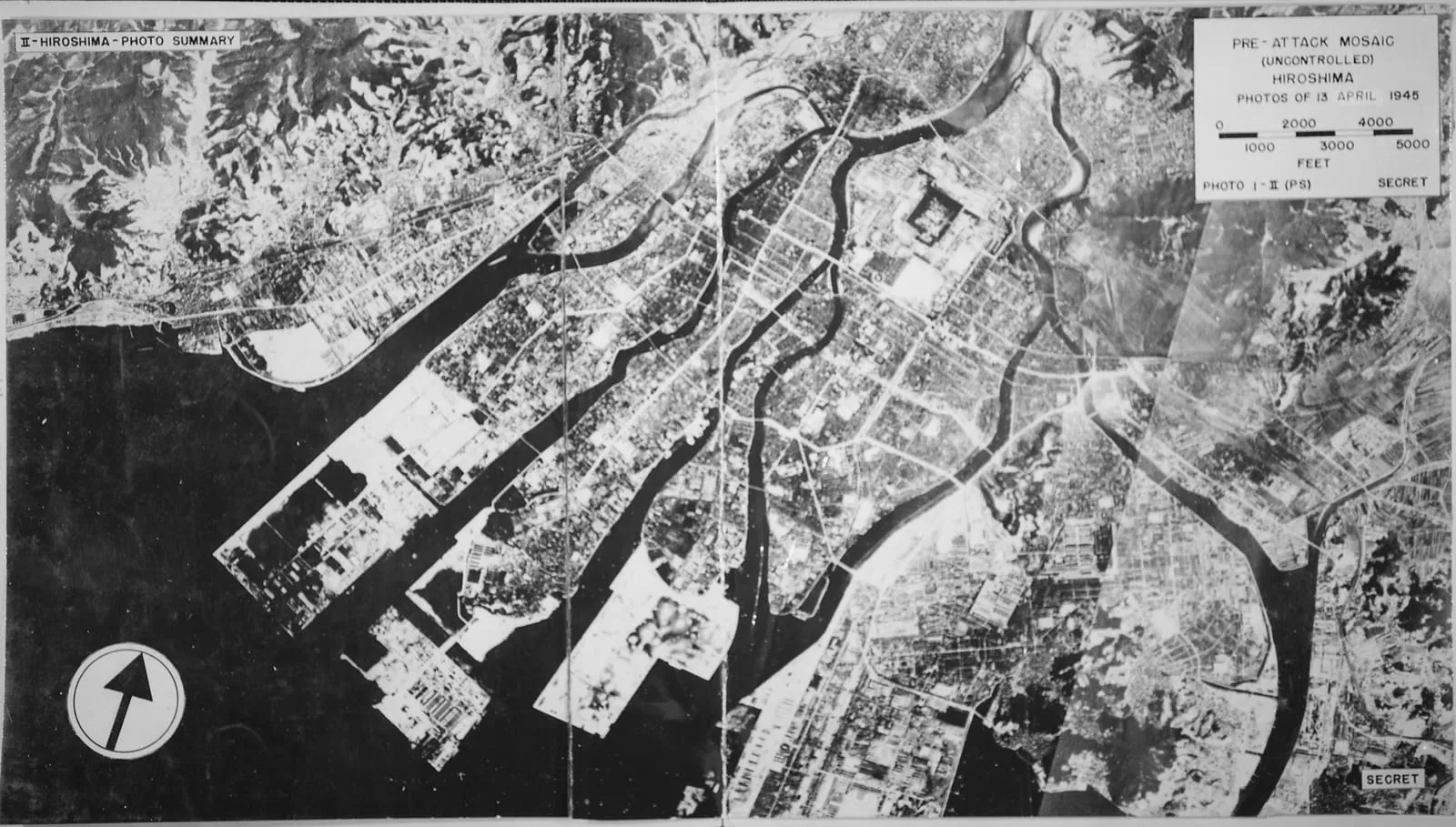
Nagasaki was never one of the reserved cities. It was bombed five times between August 1944 and 1 August 1945, and the last of these raids led to a partial evacuation of the city’s schoolchildren. Sources: 3 14
Kyoto
Kyoto, Japan’s old capital, was the committee’s first choice. Stimson would not have it. He wrote after the war: “With President Truman’s warm support I struck off the list of suggested targets the city of Kyoto.” Sources: 4
The military kept trying. On 21 July, while Stimson was at Potsdam, his aide George Harrison cabled that his military advisers “definitely favor your pet city”. Stimson replied the same day: “Aware of no factors to change my decision.” Sources: 15 16
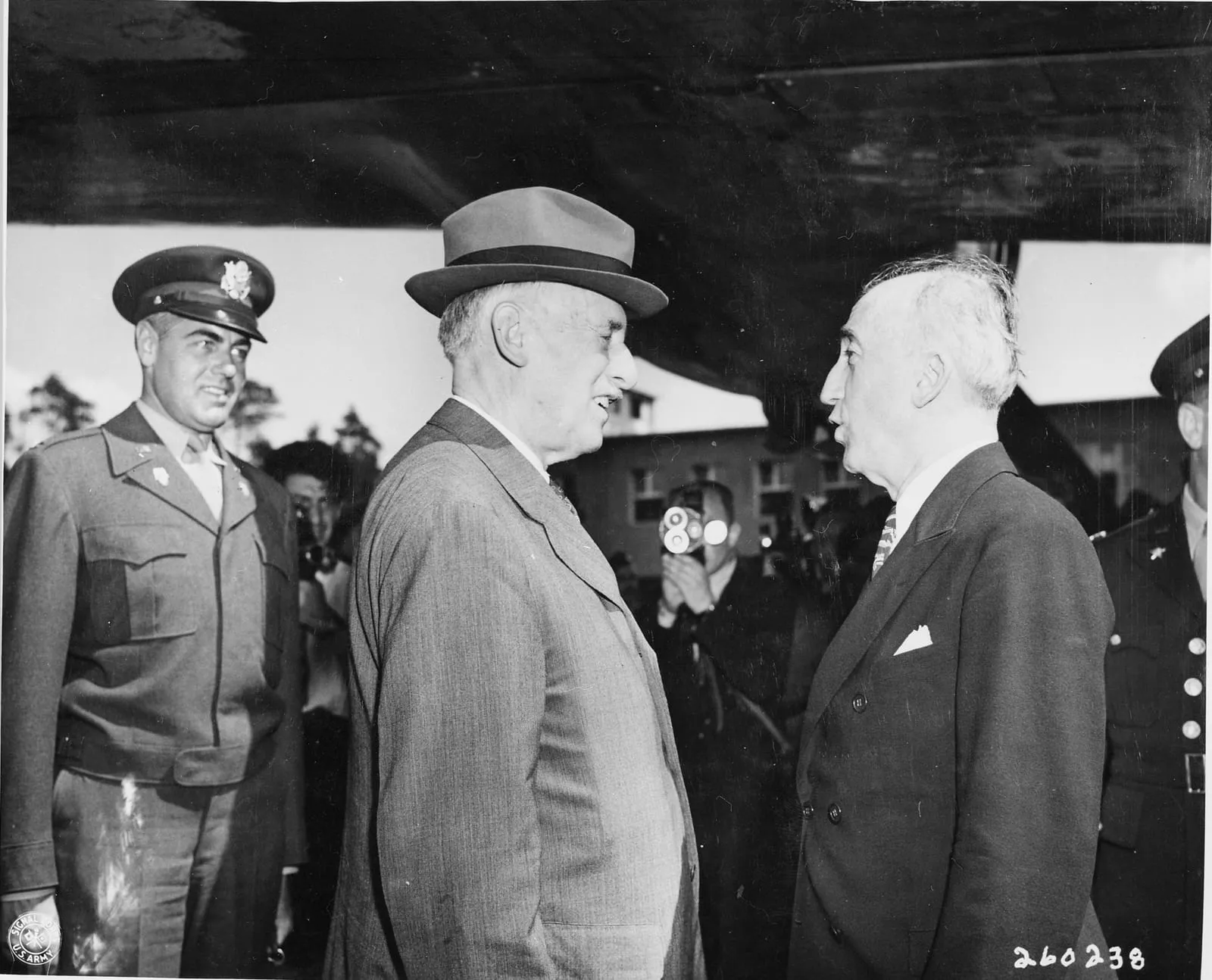
Two days later he asked for the list of targets, “always excluding the particular place against which I have decided”, and added that his decision had been confirmed by the highest authority. Sources: 17
His reason, recorded in his diary on 24 July, was political: the bitterness of destroying Kyoto might turn Japan towards the Soviet Union after the war. The diary entry is on The decision and the debate. The story that he had spent his honeymoon there is a myth, set out on Myths and mistakes. Sources: 18
Sources disagree on General Arnold, who commanded the Twentieth Air Force. The official air history says Kyoto was struck off “against the judgment of Arnold”; Stimson’s diary for 22 July says Arnold “agreed with me”. Sources: 3 18
Nagasaki joins the list
On 23 July Harrison cabled the targets in order of choice: “Hiroshima, Kokura, Niigata”. Kokura had moved up a list it was already on. Nagasaki was not yet named. Sources: 8
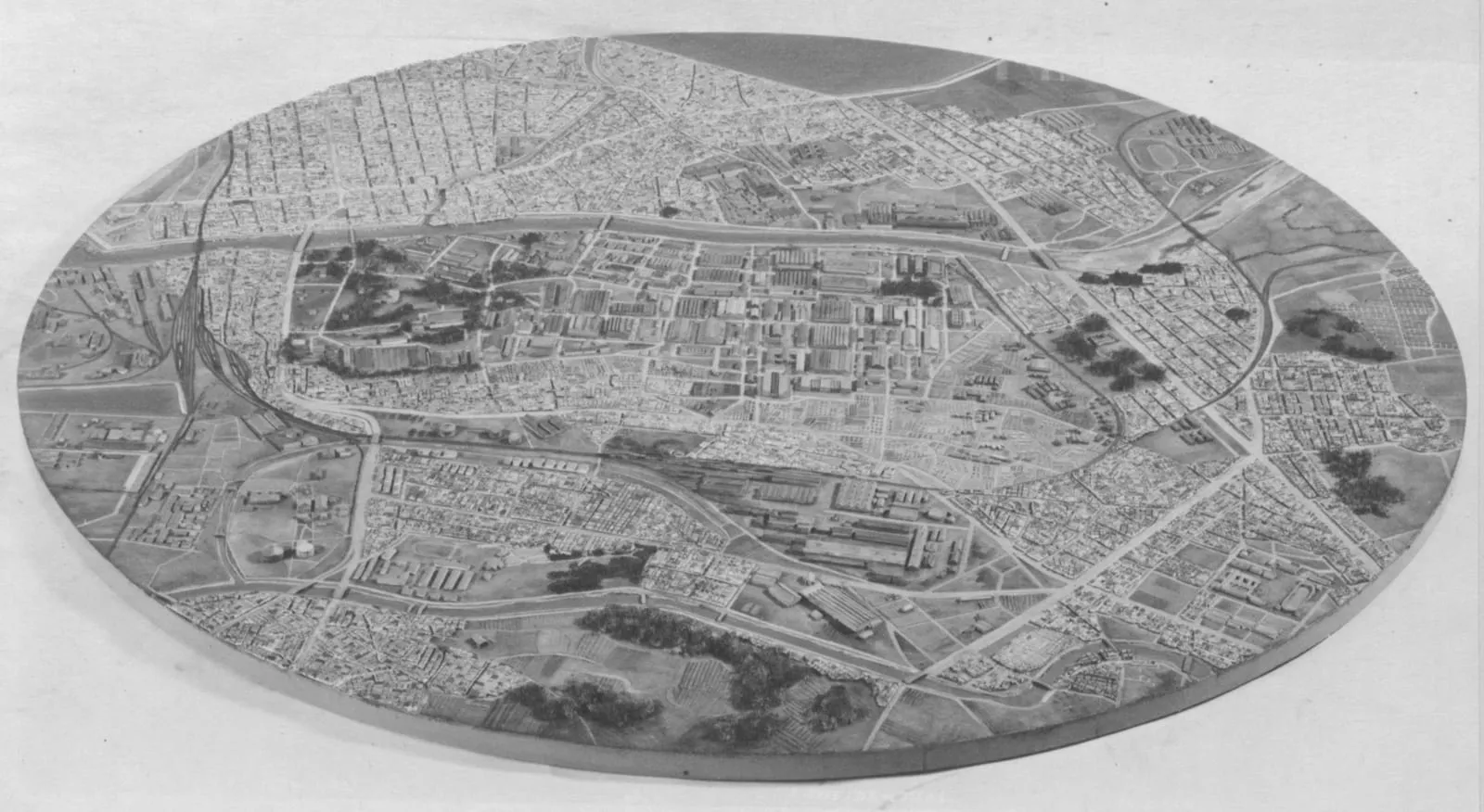
It appears the next day. A memorandum for General Arnold of 24 July lists “Hiroshima, Kokura, Niigata and Nagasaki”, and describes Nagasaki as “a major shipping and industrial center of Kyushu.” Four cities spread so far apart, it explains, gave a very high chance that one would be clear of cloud. Sources: 7
The official air history says Nagasaki was added “apparently by LeMay’s staff”, though its hills and valleys were thought poor for the purpose. No document seen gives any other reason. Sources: 3
The order
On 22 July General Marshall, at Potsdam, asked for a draft directive. General Groves wrote it, and on 25 July Marshall cabled: “S/W approves Groves directive.” The Secretary of War, Stimson, had approved it; the President is not named in these cables. Sources: 19 20 21
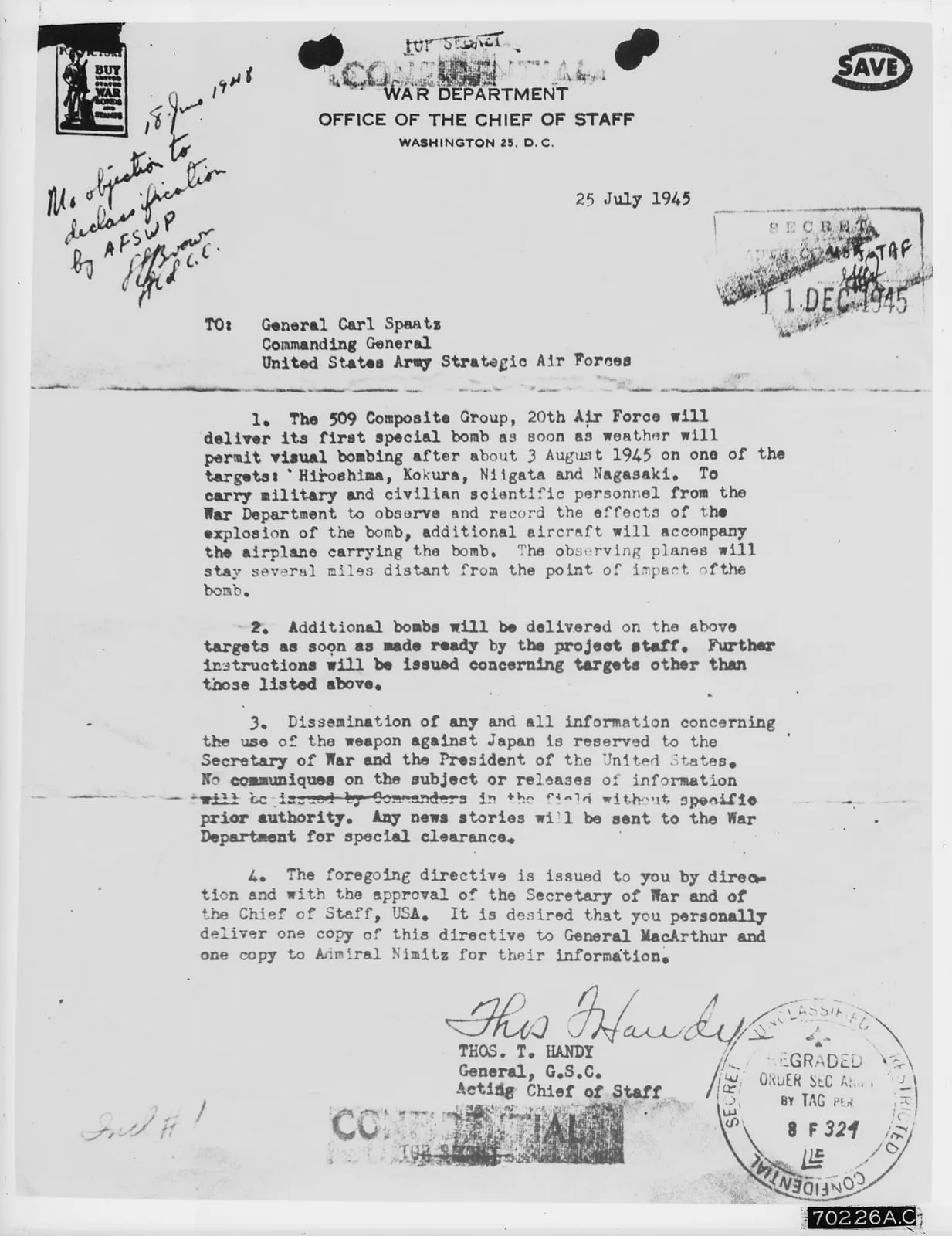
That day General Thomas Handy, acting Chief of Staff in Washington, signed the order to General Carl Spaatz. It told the 509th Composite Group to drop its first special bomb on one of four targets, “Hiroshima, Kokura, Niigata and Nagasaki”, once the weather allowed visual bombing after about 3 August. More bombs would follow as they were ready. Sources: 1 9
The field order for the Hiroshima mission was signed on 2 August. It made Hiroshima the primary target, Kokura the secondary and Nagasaki the tertiary. Sources: 3 22
Aiming points
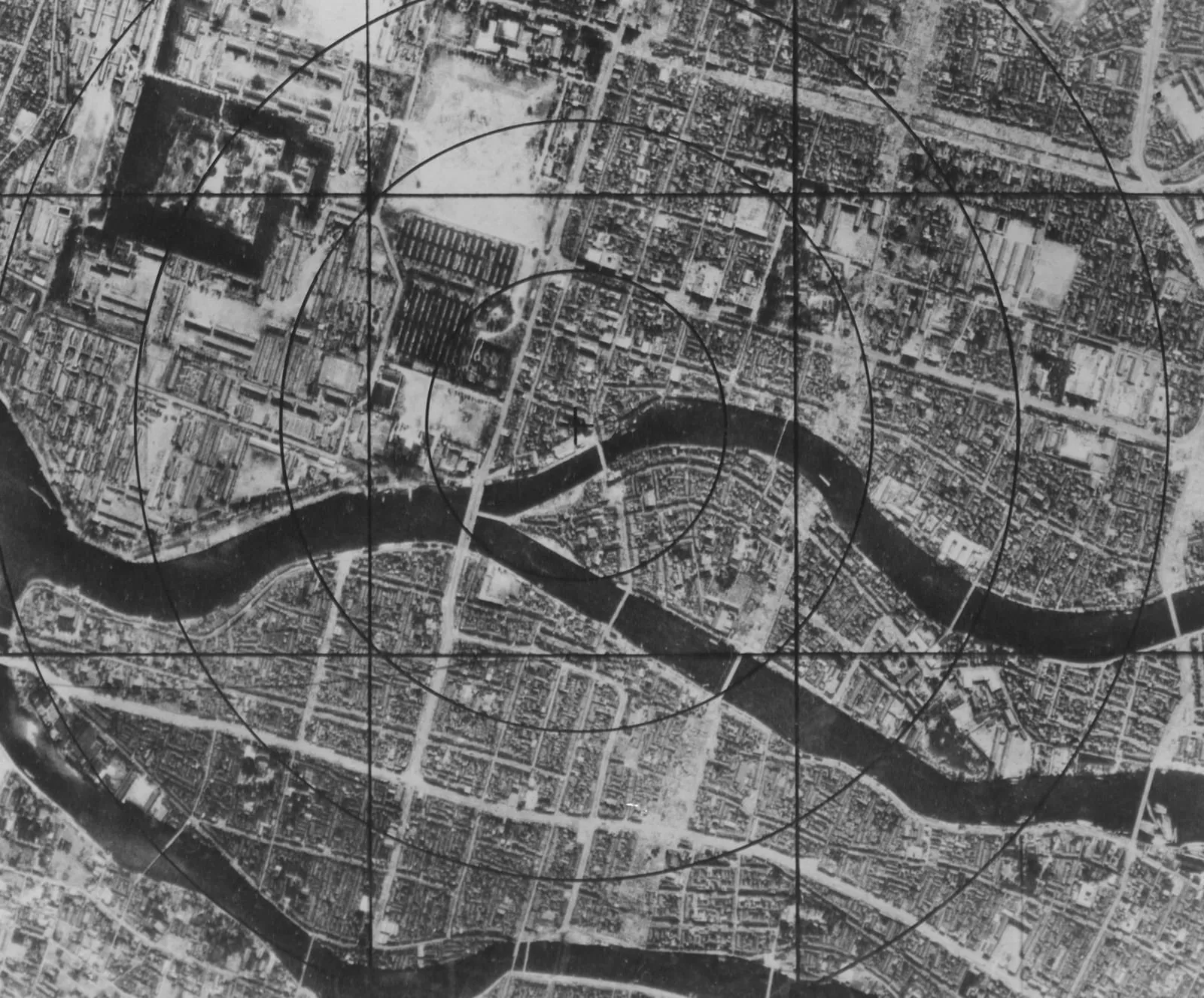
In Hiroshima the aiming point was the Aioi Bridge, chosen for its unusual T shape. The bomb exploded over Shima Hospital, about 300 metres away. Sources: 23 24
For Nagasaki the official air history found two versions. The field order named the Mitsubishi Steel and Arms Works, in the north of the city; the 509th’s own planning summary put the aiming point in the commercial district east of the harbour. Fat Man exploded about 1.5 miles northwest of the intended aiming point. Sources: 3 25
Hiroshima was believed to be the only one of the four cities with no prisoner of war camp nearby. Sources: 3
But twelve American airmen were held at the military police headquarters in the city, and died in the bombing. The Department of Energy history gives about twenty. Sources: 26 27 28 29
Weather decided
On 6 August three weather aircraft flew ahead, one to each city on the list. The report from Hiroshima was clear enough, and the city was bombed. The missions are told hour by hour on The missions. Sources: 3
Niigata was ruled out for the second mission as too distant, some 440 miles from Hiroshima, so the targets on 9 August were Kokura and then Nagasaki. Over Kokura, smoke from a fire raid on neighbouring Yawata the day before and morning haze hid the aiming point through three bomb runs, and the bomb fell on Nagasaki. Sources: 3 14 25 30 31
How historians read it
The official air history saw Hiroshima, the most important of the reserved cities, as a natural choice. Sources: 3
Wellerstein argues that the fight over Kyoto left Truman believing that Hiroshima was a purely military target. The historian Sean Malloy argues that Groves withheld the committee’s conclusion that the bomb would be aimed at a city centre, and that Stimson deceived himself that a war plant among workers’ homes was a military target. Sources: 6 9
This site does not choose between these readings. The wider argument is on The decision and the debate.