Britain's part, from Birmingham to Polaris
Britain and the bomb
Britain was the first to show that an atomic bomb could be made, then decided it could not build one at home in wartime. A memorandum written in Birmingham in 1940 and a report in 1941 set the Americans going, British scientists helped build the bomb, and in July 1945 Britain agreed to its use against Japan. Sources: 1 2 3 4
Birmingham, 1940
In March 1940 two refugee physicists at the University of Birmingham, Otto Frisch from Austria and Rudolf Peierls from Germany, wrote a short memorandum. A lump of uranium 235 of about one pound, they calculated, would explode with the force of about 1,000 tons of dynamite. Sources: 1 5
They called such a bomb practically irresistible, and warned that it could probably not be used without killing large numbers of civilians. They also thought it quite conceivable that Germany was already developing one. Sources: 1
Their figure for the amount needed was far too small. A year later the MAUD Committee put it at some 25 lb. But the principle was right. Sources: 1 2
The MAUD Committee
In April 1940 a small committee of scientists was set up under George Thomson of Imperial College to examine the idea. Its name came from a telegram passing on news from Niels Bohr in occupied Copenhagen, which ended with a request to inform Cockcroft and Maud Ray Kent. Sources: 3 5 7
Some suspected a code. Maud Ray had once been a governess in the Bohr household, and lived in Kent. Sources: 5 7
In July 1941 the committee reported that a uranium bomb was practicable and likely to lead to decisive results in the war. Some 25 lb of uranium 235 would equal 1,800 tons of TNT, and the material for the first bomb could be ready by the end of 1943. Sources: 2 5
The report reached Washington that summer, through official channels and through the Australian physicist Mark Oliphant, who found that the chairman of the American uranium committee had put it in his safe. On 9 October 1941 Vannevar Bush used its conclusions to win Roosevelt’s support. Sources: 3 7 8
Two days later Roosevelt wrote to Churchill suggesting that the work be coordinated or even jointly conducted. Churchill replied in December: “I need not assure you of our readiness to collaborate.” Sources: 9
Tube Alloys
Churchill had already acted. At the end of August 1941 he passed the question to the Chiefs of Staff: “Although personally I am quite content with the existing explosives, I feel we must not stand in the path of improvement.” Sources: 3
In November 1941 the work passed to a new body within the Department of Scientific and Industrial Research, given the cover name of the Directorate of Tube Alloys. Wallace Akers of Imperial Chemical Industries ran it, and Sir John Anderson, the Lord President of the Council, was the minister responsible. Sources: 3 10
Building the great separation plants in Britain would have drawn men and money from the rest of the war effort, within reach of German bombers. When Churchill and Roosevelt met in June 1942, Churchill was relieved to hear that the United States would have to do the job. Sources: 3 9
The difference in scale was enormous. In 1943 the American project was expected to cost more than a thousand million dollars; Britain spent about half a million pounds that year. Sources: 5
Shut out, then let back in
As the US Army took over the American project, Vannevar Bush and James Conant limited the exchange of information to what Britain could use in the war itself. Roosevelt approved on 28 December 1942, and in the words of the official American history, interchange slowed to a standstill. Sources: 3
It came as a great shock to the British. In February 1943 Churchill sent Roosevelt’s adviser Harry Hopkins a memorandum arguing that the plants had gone to America on strategic grounds, not because of any technical inability on the part of the British. Sources: 5 9
The repair came that summer. At 10 Downing Street on 22 July 1943 Churchill himself proposed the terms, among them that using the bomb in war would need common assent. The Quebec Agreement, signed on 19 August 1943, put this in plain words. Sources: 3 5 6
Its first two clauses read: “First, that we will never use this agency against each other. Secondly, that we will not use it against third parties without each other’s consent.” In return, Britain left any industrial or commercial advantages after the war to terms set by the President. Sources: 6
What became of these promises after the war is told, document by document, on After 1945.
The British Mission
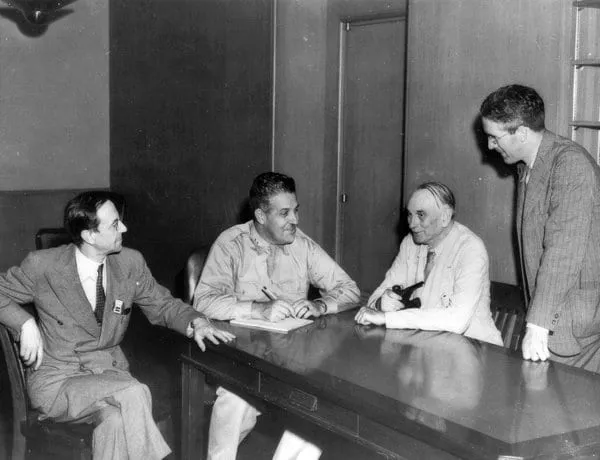
After Quebec, British scientists went to work inside the Manhattan Project: a team in New York on gaseous diffusion, about 35 at Berkeley on electromagnetic separation, and 19 at Los Alamos. Others worked at the laboratory in Montreal that Britain shared with Canada. Sources: 3 5 11
The 19 at Los Alamos do not include the head of the mission, James Chadwick, who worked mostly in Washington, or the consultants Niels Bohr and Geoffrey Taylor. Six of the 19 led joint groups. Sources: 5
Much depended on the working friendship between Chadwick and General Groves. Groves himself, the official American history says, detested the joint enterprise, and after the war boasted that he dragged his feet. Sources: 3 5
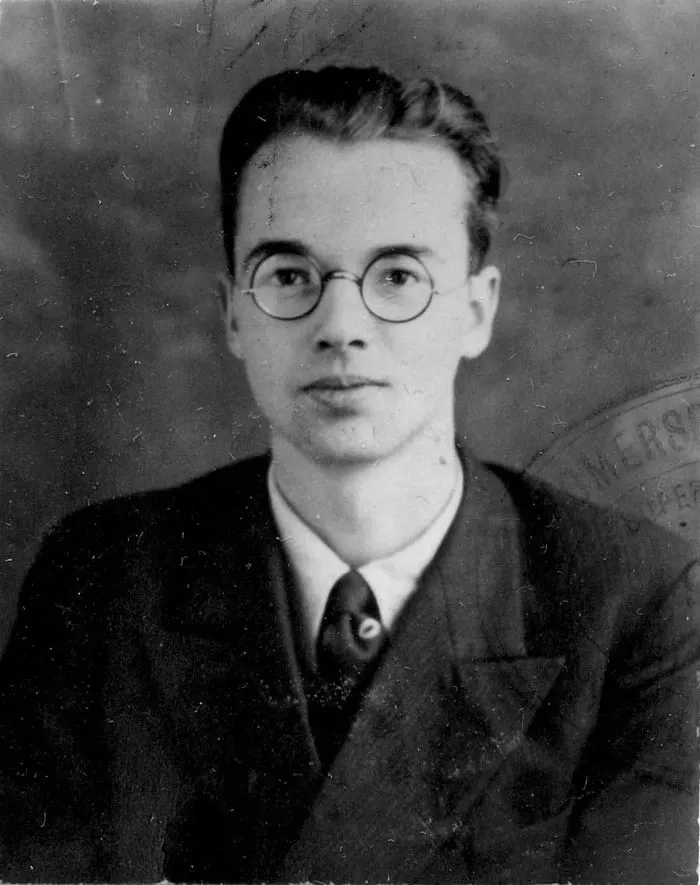
One of the 19 betrayed them all. Klaus Fuchs passed atomic secrets to the Soviet Union, in Britain and in America, until he was exposed in 1949; he confessed in January 1950. His story is told on The atomic spies. Sources: 12 13
-
Head of the British Mission
James Chadwick
Physicist, English 1891 to 1974
Washington, with time at Los Alamos
- In the war
- Built a close working partnership with General Groves, and advised the Combined Policy Committee.
- Later
- Knighted in 1945. He had already won the Nobel Prize in Physics in 1935, for discovering the neutron.
-
Blast and height of burst
William Penney
Mathematician, born in Gibraltar 1909 to 1991
Los Alamos
- In the war
- Worked on the bombs’ effects and the height of burst, then watched Nagasaki from Big Stink.
- Later
- Led the British bomb, first tested in 1952.
-
Critical Assemblies group leader
Otto Frisch
Physicist, Austrian-born 1904 to 1979
Los Alamos
- In the war
- Co-wrote the 1940 memorandum, then led the group that first measured the critical mass of uranium 235.
- Later
- Head of nuclear physics at the Cavendish Laboratory, Cambridge, from 1947.
-
Implosion
Rudolf Peierls
Physicist, German-born, British from 1940 1907 to 1995
New York, then Los Alamos
- In the war
- Co-wrote the 1940 memorandum, then led the implosion dynamics group at Los Alamos.
- Later
- A professor at Oxford, he was knighted in 1968.
-
Theoretical Division, and Soviet spy
Klaus Fuchs
Physicist, German-born, British from 1942 1911 to 1988
New York, then Los Alamos
- In the war
- Passed atomic secrets to the Soviet Union in Britain and in America.
- Later
- Arrested in February 1950 and sentenced to 14 years; released in 1959, he went to East Germany.
-
Electronics
Ernest Titterton
Physicist, English 1916 to 1990
Los Alamos
- In the war
- Triggered the Trinity test, and was the last of the mission to leave Los Alamos, in 1947.
- Later
- Professor of nuclear physics at the Australian National University from 1950.
-
Explosive lenses
James Tuck
Physicist, English 1910 to 1980
Los Alamos
- In the war
- Helped originate the explosive lenses that made implosion work.
- Later
- Returned to Los Alamos in 1950 and led its research into fusion power.
-
Super Experiments group leader
Egon Bretscher
Physicist, Swiss-born 1901 to 1973
Los Alamos
- In the war
- Led experiments for the hydrogen bomb, then called the Super.
- Later
- Head of nuclear physics at Harwell from 1948 to 1966.
-
Left the project
Joseph Rotblat
Physicist, Polish, British from 1946 1908 to 2005
Los Alamos
- In the war
- Left late in 1944, once it was clear that Germany would not build a bomb.
- Later
- Shared the Nobel Peace Prize in 1995 with the Pugwash Conferences, which he helped found.
-
Composite Weapons group leader
George Placzek
Physicist, Czech 1905 to 1955
Montreal, then Los Alamos
- In the war
- Led theory at the laboratory in Montreal, then went to Los Alamos in May 1945.
- Later
- Joined the Institute for Advanced Study, Princeton, in 1948.
-
Electromagnetic separation
Mark Oliphant
Physicist, Australian 1901 to 2000
Berkeley
- In the war
- Pressed the Americans to act on the MAUD report in 1941, then worked with Ernest Lawrence at Berkeley as Chadwick’s deputy.
- Later
- Governor of South Australia from 1971.
-
Berkeley group leader
Harrie Massey
Physicist, Australian 1908 to 1983
Berkeley
- In the war
- Led a group at Berkeley on separating uranium 235, and the British team there from 1945.
- Later
- First chairman of the council of the European Space Research Organisation.
Sources: 36
-
Minister for Tube Alloys
Sir John Anderson
Politician, Scottish 1882 to 1958
London
- In the war
- As Lord President of the Council, and then as Chancellor of the Exchequer, he kept charge of Tube Alloys.
- Later
- Became Viscount Waverley in 1952.
-
Combined Policy Committee
Sir Henry Maitland Wilson
Field Marshal, British Army 1881 to 1964
Washington
- In the war
- On 4 July 1945 told the committee that the British Government agreed to the bomb being used against Japan.
- Later
- Headed the British Joint Staff Mission in Washington until 1947.
-
British observer
Leonard Cheshire
Group Captain, RAF 1917 to 1992
Tinian
- In the war
- Watched the Nagasaki bomb from Big Stink as the official British observer.
- Later
- Founded homes for disabled people in 1948, the start of the charity that carries his name.
Britain’s consent
Under the Quebec Agreement the bomb could not be used against Japan without Britain’s agreement. On 30 April 1945 Field Marshal Sir Henry Maitland Wilson, Britain’s military representative on the Combined Policy Committee in Washington, warned London that the Americans would soon need its view. Churchill initialled his approval of the text on 1 July. Sources: 42
The committee met at the Pentagon on 4 July 1945. Its minutes record that “Field Marshal Wilson stated that the British Government concurred in the use of the T. A. weapon against Japan.” T. A. stood for Tube Alloys. Sources: 4
The same meeting gave all the uranium bought for the two countries during the war to the United States. The minutes note that this would leave Great Britain without any reserve of supplies of this material for future use. Sources: 4
On 16 August 1945 Churchill told the Commons that “Great Britain had a right to be consulted in accordance with Anglo-American agreements”, and that the decision to use the bomb was taken by President Truman and himself at Potsdam. The formal consent had already been recorded in Washington. Sources: 42 43
Over Nagasaki
Two British observers flew on the Nagasaki mission in the camera aircraft Big Stink: Group Captain Leonard Cheshire, Britain’s official observer, and William Penney. Sources: 18 39 The crews tells what they saw.
Shut out again
The McMahon Act of August 1946 ended the sharing, and in January 1947 a small group of ministers decided that Britain would build its own bomb. After 1945 tells that story, and Fuchs’s.
Britain then gave up its veto. At Blair House on 7 January 1948 the two governments agreed that all their earlier atomic agreements, apart from a few listed, should be regarded as null and of no effect. The Quebec Agreement was not among the exceptions, so the consent clause went with it. Sources: 44 45 46
Britain also gave the United States all the uranium from the Belgian Congo for 1948 and 1949, in return for cooperation in a short list of technical fields. The Under Secretary of State, Robert Lovett, told Congress: “We stand to learn more than we give.” Sources: 44 45 46
Britain’s own bomb
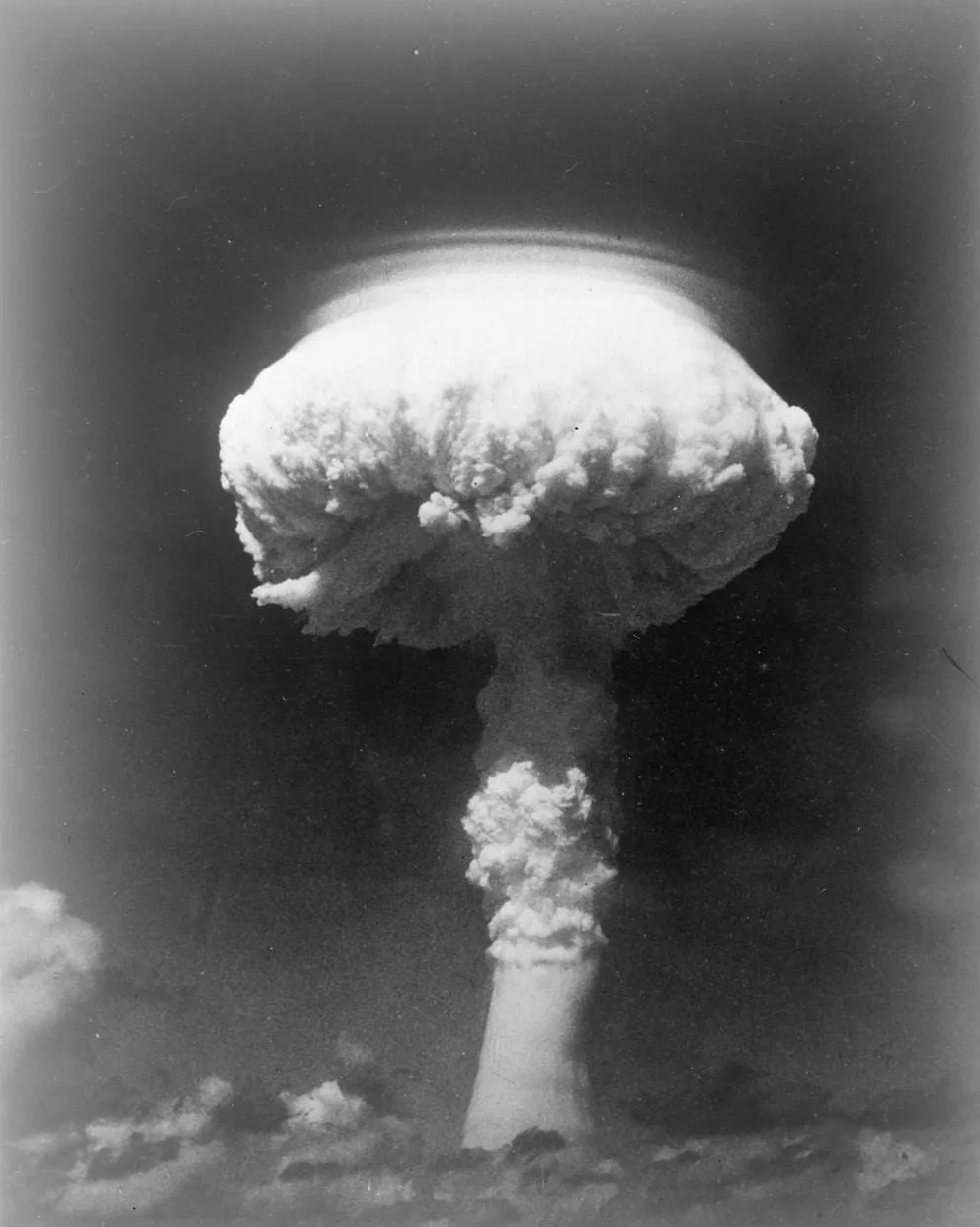
The work moved to a new Atomic Weapons Research Establishment at Aldermaston on 1 April 1950, with William Penney as its first director. The plutonium came from two reactors at Windscale, the first of them working by 1950. Sources: 47 48 49
After the first British test, Hurricane, in October 1952, the first Blue Danube atomic bombs reached the RAF at Wittering in November 1953. The first squadron of Valiant bombers that could carry them formed in 1955. Sources: 50 51
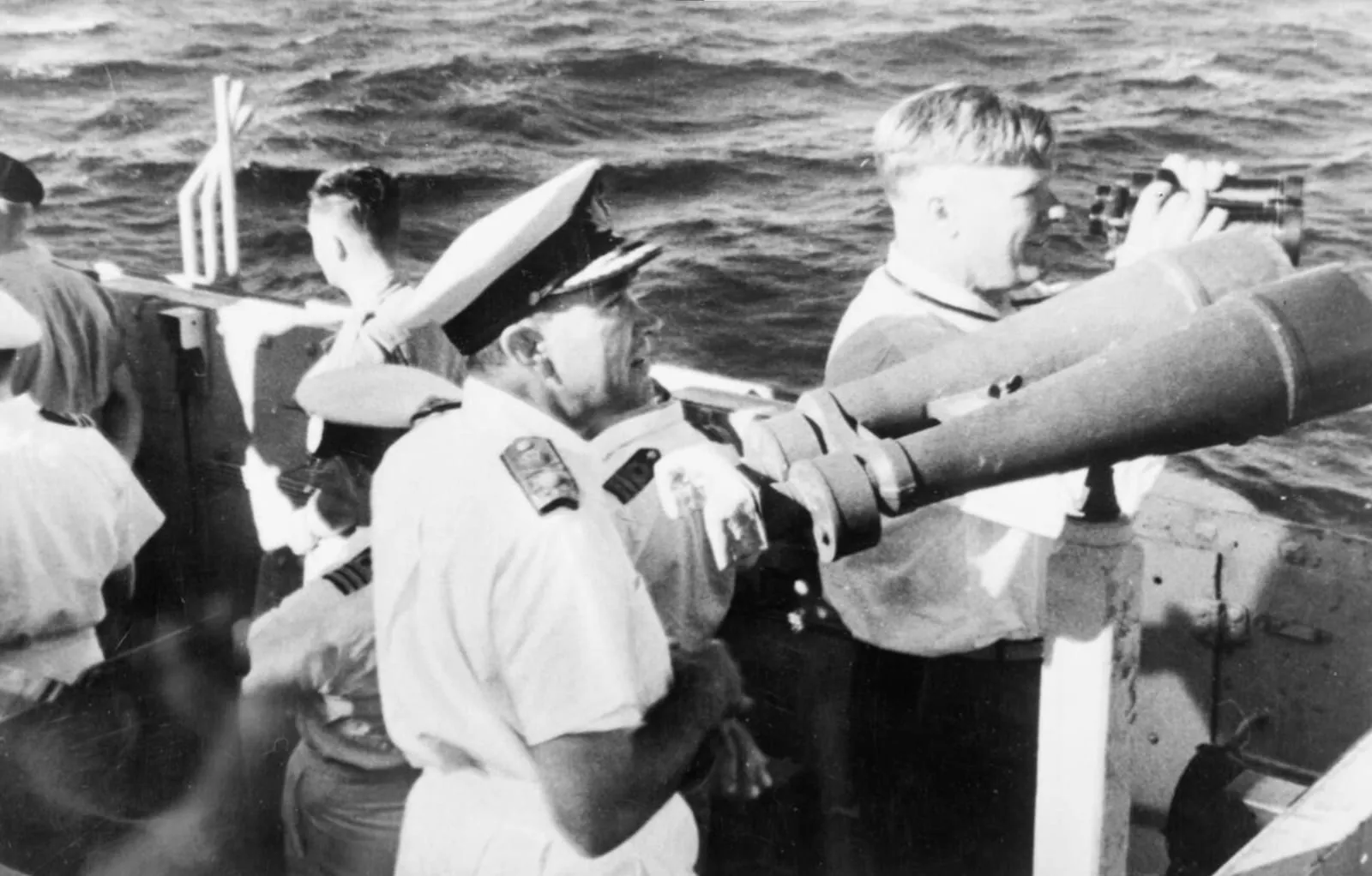
In 1957 and 1958 Britain tested hydrogen bombs at Malden Island and Christmas Island in the Pacific, in Operation Grapple. None of the three shots at Malden Island reached the megaton range, although the government said at the time that one had. The first, on 15 May 1957, gave about 300 kilotons. Sources: 52 53
The first true megaton explosion was Grapple X, off Christmas Island on 8 November 1957, at 1.8 megatons. Some historians call the 1957 claims a bluff aimed at Washington; others reply that American observers already knew the yields. Sources: 52 53
The partnership restored
Churchill had asked Eisenhower about it at Bermuda in December 1953. The change came after the Soviet Union launched Sputnik on 4 October 1957: three weeks later Eisenhower and Macmillan met in Washington, and on 25 October declared that the President would ask Congress to amend the Atomic Energy Act. Sources: 52 54 55
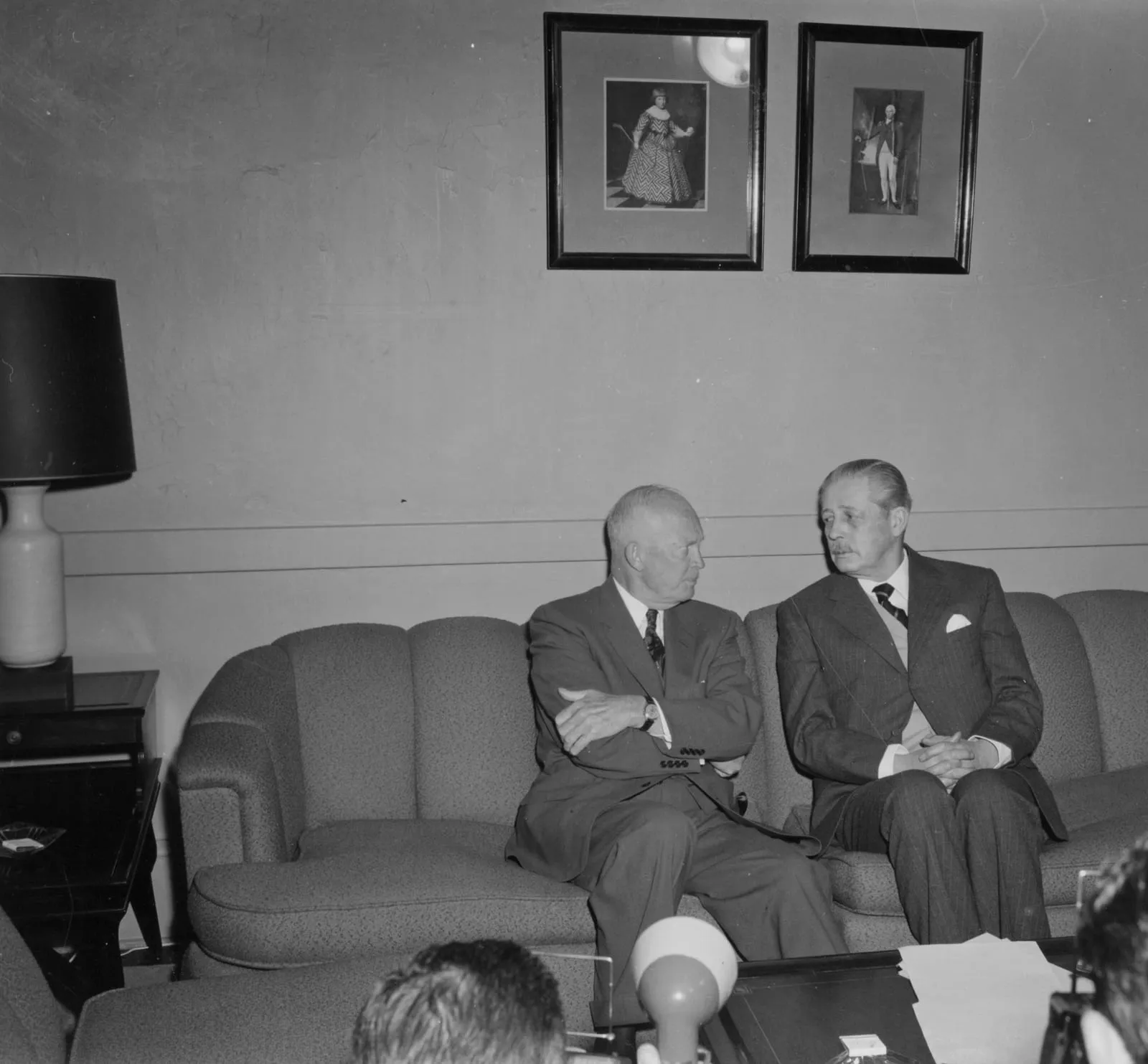
Congress changed the law in June 1958 for allies that had made substantial progress with atomic weapons, and Britain, after Grapple, was the only one. The Mutual Defence Agreement was signed on 3 July 1958. It allows the two countries to exchange nuclear information and materials, but not nuclear weapons. Sources: 56 57
Renewed every ten years from the 1980s, the agreement was made permanent by an amendment signed on 25 July 2024, which came into force on 14 November 2024. Sources: 56
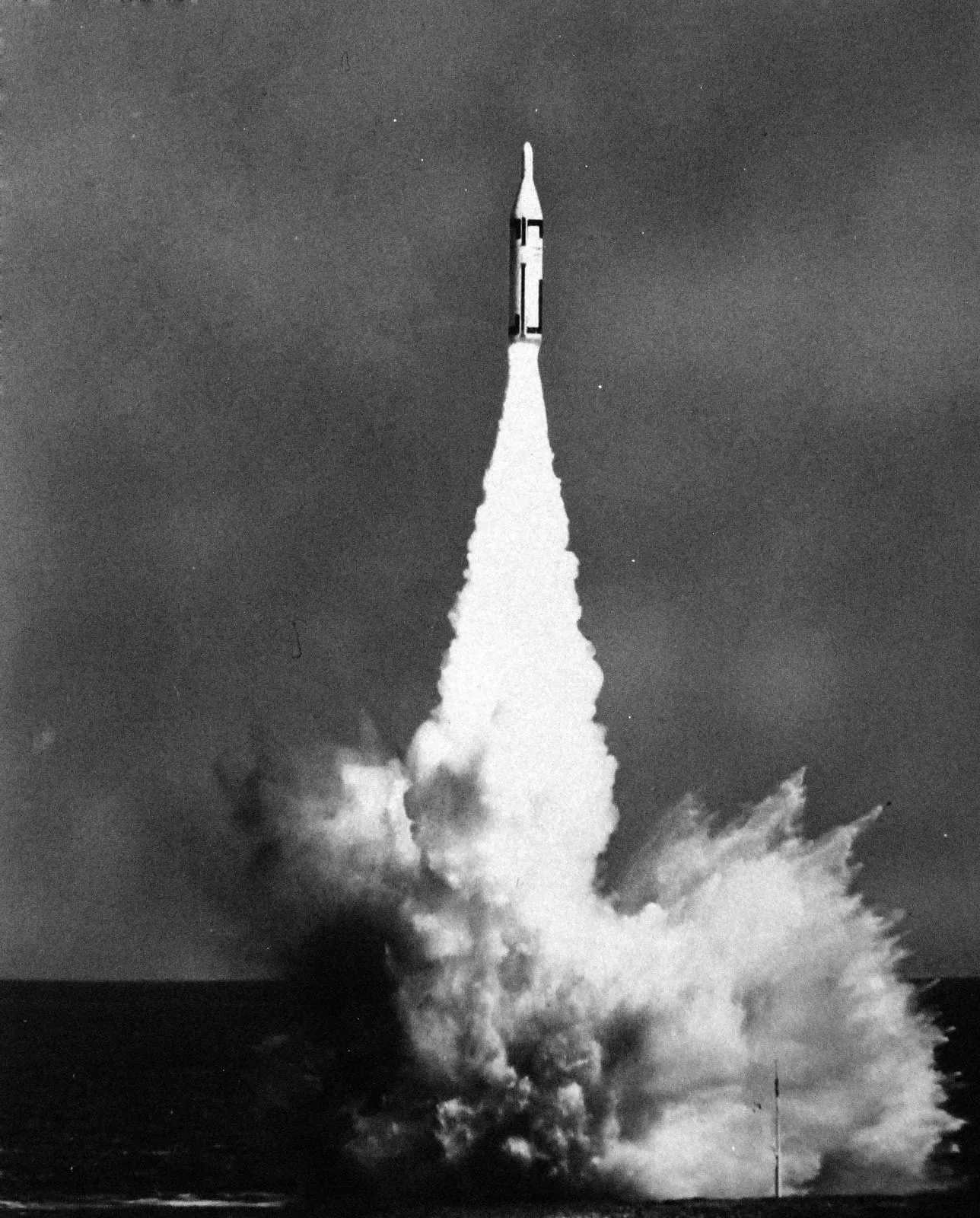
When the Americans cancelled the Skybolt missile chosen for Britain’s bombers, Kennedy and Macmillan agreed at Nassau in December 1962 that the United States would supply Polaris missiles, less warheads, for British submarines. Britain would build the submarines and the warheads, and Polaris entered service with the Royal Navy in 1968. Sources: 58 59
A promise broken?
Did the United States break its word? The records give each side its case.
On the American side, Truman said in April 1947 that he remembered Churchill saying the Quebec Agreement did not extend beyond the war. The Senate Foreign Relations Committee had never been told of the wartime agreements, and James Forrestal thought any obligation had been wiped out by American loans to Britain. Sources: 46
A British government historian adds the wider reasons: Americans thought a nuclear plant in Britain would be insecure and at odds with international control, some Republicans wanted to discredit Roosevelt’s secret wartime deals, and the Canadian spy case of 1946 was fresh in the memory. Sources: 60
On the British side, Attlee told Truman in December 1946 that Britain attached the highest importance to the partnership going on. When it did not, he told Bevin: “We ought not to give the Americans the impression that we cannot get on without them.” Sources: 60 61
The partnership came back on new terms in 1958, once Britain had shown with Grapple that it could build a hydrogen bomb of its own. The wartime papers, including the senator who later said he had not known of them, are on After 1945.