Two flights, three days apart. On 6 August 1945 the Hiroshima mission went to plan. On 9 August the Nagasaki mission met trouble at almost every step, from a failed fuel pump to an emergency landing. Every time on this page is Tinian time; Japan time, one hour behind, is shown beside it for events over Japan. Sources: 1,2,3
6 August 1945: Tinian to Iwo Jima, where the three aircraft met, then on to Hiroshima. Enola Gay came home the same way. Places are shown in their true positions; coastlines are left out.Sources: 2,7,8,9,10,119 August 1945: Tinian to Yakushima, where Bockscar waited, then Kokura, then Nagasaki. Short of fuel, it landed on Okinawa (dashed) before returning to Tinian.Sources: 2,6,7,8,9,10
Hiroshima, 6 August
Seven B-29s took part. Three went ahead to check the weather, one waited on Iwo Jima as a spare, and three flew to Hiroshima: Enola Gay with the bomb, The Great Artiste with blast instruments and Necessary Evil with cameras. Sources: 2,4
00:00
Final briefing
Tibbets briefs the crews. Seven B-29s will fly, and Hiroshima is the primary target.Sources: 2
01:37
Weather planes take off
Straight Flush, Jabit III and Full House leave to check the weather over Hiroshima, Kokura and Nagasaki.Sources: 2,12
01:51
The spare leaves
Big Stink flies to Iwo Jima, in case Enola Gay has to land there.Sources: 2
02:45
Enola Gay takes off
Tibbets lifts off from North Field with Little Boy aboard. The Great Artiste and Necessary Evil follow two and four minutes later.Sources: 1,11,12,13
03:00
Arming in flight
In the bomb bay, Parsons, helped by Jeppson, loads the gun charge. His log records the job finished at 03:15.Sources: 2,11
06:00
Meeting over Iwo Jima
The three aircraft meet over Iwo Jima and turn north for Japan.Sources: 2,11,13
07:30
Red plugs in
Jeppson swaps the green safety plugs for red ones. Little Boy is now live.Sources: 11
08:09Japan 07:09
Alert in Hiroshima
Air raid sirens sound in Hiroshima as the weather plane passes over.Sources: 2,14,15
08:24Japan 07:24
Weather: bomb the primary
Straight Flush reports less than three tenths cloud over Hiroshima and advises bombing the primary target.Sources: 2
08:31Japan 07:31
All clear in Hiroshima
The warning is lifted, and people leave the shelters.Sources: 2,14,15
Van Kirk logs the initial point, and Ferebee takes over the aim.Sources: 2,13
09:15Japan 08:15
Bomb released
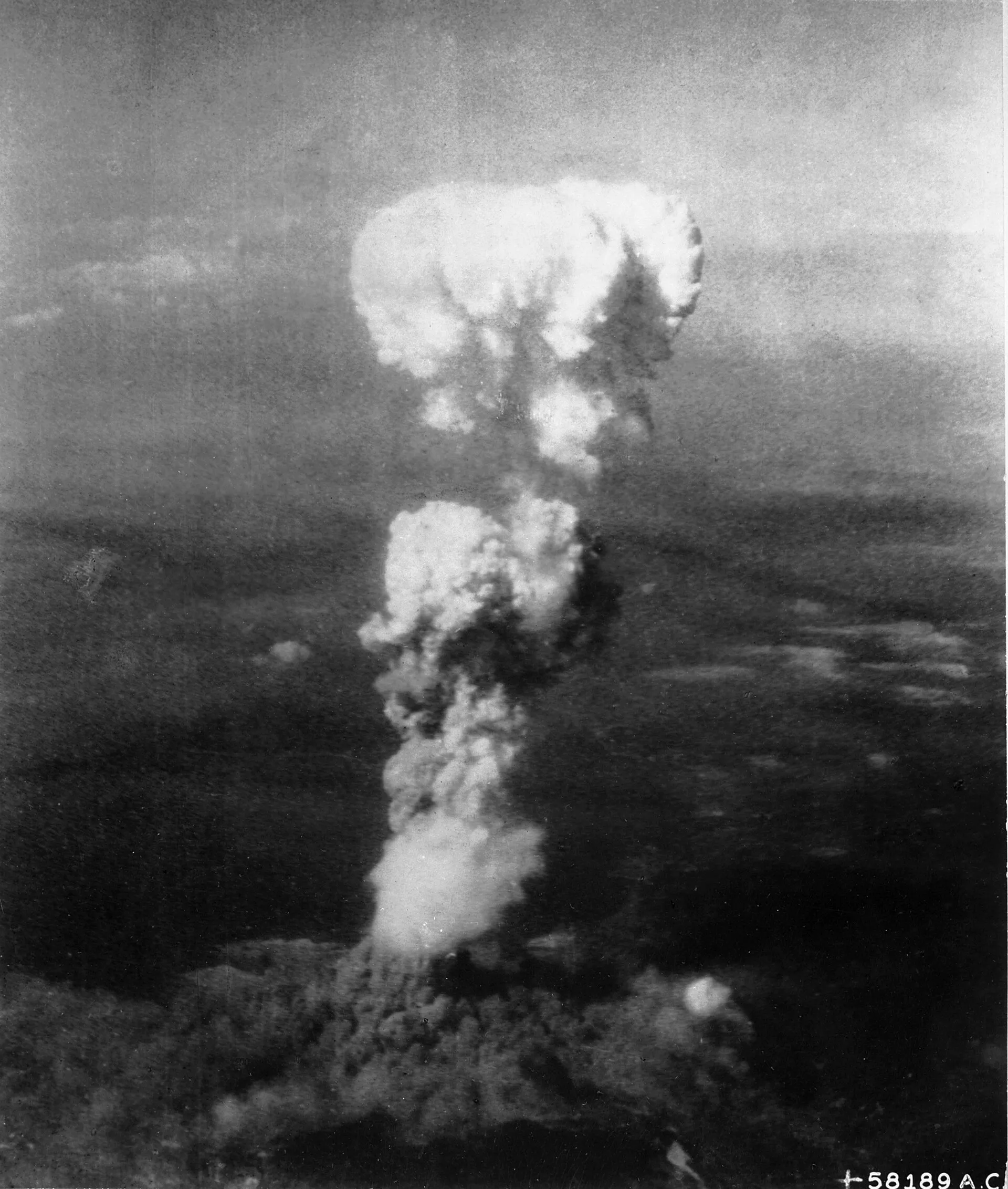
Little Boy falls from 31,060 feet, aimed at the Aioi Bridge. Tibbets turns hard away.Sources: 1,2,11
09:16Japan 08:16
The explosion
About 43 seconds after release, Little Boy explodes about 600 metres above the city.Sources: 1,5,16
09:30
The first report
Parsons radios: “Results clearcut, successful in all respects.”Sources: 12
10:41
The cloud out of sight
363 miles from Hiroshima, the crew lose sight of the mushroom cloud.Sources: 11
14:58
Home
Enola Gay lands on Tinian, 12 hours and 13 minutes after take-off.Sources: 1,2,12,13
Next day
The world is told
At 11:00 on 6 August in Washington, 01:00 on 7 August on Tinian, the White House releases President Truman’s statement.Sources: 5,17
The cloud over Hiroshima, photographed by George Caron, 6 August 1945. George R. Caron, US Army Air Forces (National Archives), Public domain (US government), source
Nagasaki, 9 August
Six B-29s took part. Two went ahead to check the weather, one waited on Iwo Jima, and three set out together: Bockscar with the bomb, The Great Artiste with instruments and Big Stink with cameras. Sources: 4
22:00
Fat Man loaded
Fat Man is loaded into Bockscar on the evening of 8 August.Sources: 2,3
23:00
Briefing
The meeting point moves from Iwo Jima to Yakushima because of the weather. The orders are to wait there no more than 15 minutes, and to bomb only if the target can be seen.Sources: 2,3
02:15
A fuel pump fails
The flight engineer finds the pump for a reserve fuel tank is not working. About 600 US gallons cannot be used. The mission goes ahead.Sources: 2,3
03:47
Bockscar takes off
Sweeney takes off from North Field. The primary target is the arsenal at Kokura. The Great Artiste and Big Stink follow.Sources: 1,2,6,18
04:00
Red plugs in
Ashworth swaps the green safety plugs for red ones. Fat Man is now live.Sources: 2,19
09:10Japan 08:10
At Yakushima
Bockscar reaches the meeting point and The Great Artiste joins it. Big Stink, circling higher, does not.Sources: 2,6,20
09:50Japan 08:50
Leaving without Big Stink
After about 40 minutes, far longer than ordered, Bockscar and The Great Artiste head for Kokura.Sources: 2,6
10:44Japan 09:44
Kokura hidden
Haze and smoke from a fire raid on nearby Yawata hide the aiming point. Three runs are made, and it is never seen.Sources: 2,3,6
11:32Japan 10:32
Turn for Nagasaki
With fuel now critical, Bockscar turns for its second target, Nagasaki.Sources: 2,21
11:50Japan 10:50
Nagasaki under cloud
The city is covered by cloud and there is fuel for one run only. The run begins on radar, against orders.Sources: 3,6,22
11:58Japan 10:58
A gap in the cloud
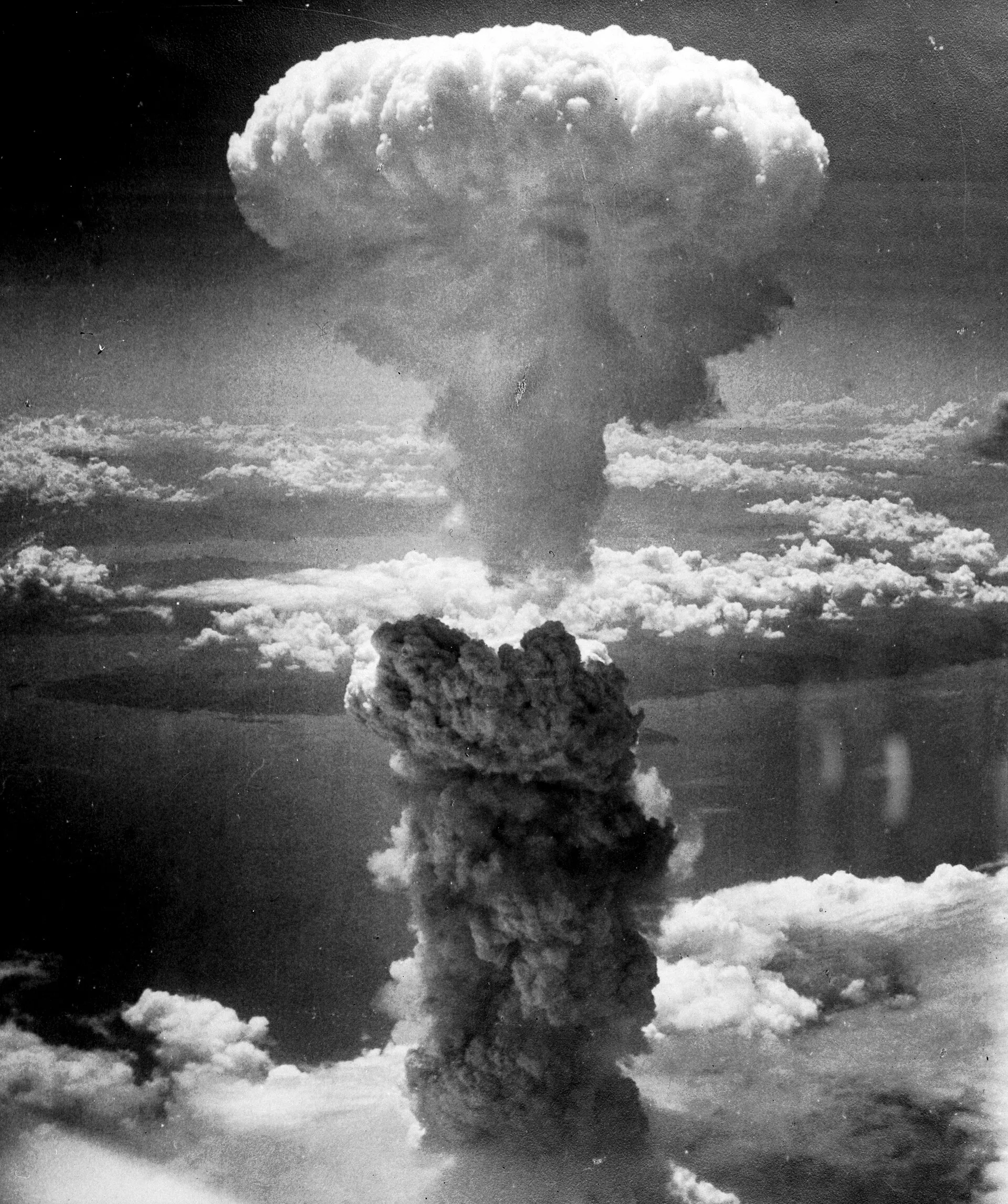
The bombardier, Kermit Beahan, sees the city through a gap and releases Fat Man over the Urakami valley.Sources: 2,20
12:02Japan 11:02
The explosion
Fat Man explodes about 500 metres above Matsuyama-machi.Sources: 2,18,23
12:05Japan 11:05
Course for Okinawa
Too short of fuel to reach Tinian, Bockscar heads for Yontan airfield on Okinawa.Sources: 6,21
13:51
Emergency landing
With no answer from the tower, the crew fire every flare and land fast. By one account about seven gallons of fuel are left.Sources: 3,6,19
17:06
Back to Tinian
After refuelling, Bockscar leaves Okinawa for Tinian, landing late that evening.Sources: 6
The cloud over Nagasaki, photographed by Charles Levy, 9 August 1945. Charles Levy, US Army Air Forces (National Archives), Public domain (US government), source
Why the times differ
The records do not always agree to the minute. They come from flight logs, radio messages and memories written down later, some kept in Tinian time, some in Japan time and some in Greenwich time. Sources: 2,12,23
This page follows the National Park Service and the Atomic Heritage Foundation, which use Tinian time, and checks them against the flight logs kept by Parsons and Ashworth. Where sources differ by more than a little, the notes below say so. Sources: 1,6,11
The Nagasaki release is timed between 11:50 (Ashworth's log) and 12:01 Tinian time in different records. The landing on Okinawa is given as 13:51 (Ashworth's log) or 14:00 (the Air Force history).
The Air Force's own messages give the three weather planes' take-off times as 01:37, 01:40 and 01:46.
Parsons's log has the arming finished at 03:15. The Atomic Heritage Foundation timeline says 03:20.
Times for the meeting over Iwo Jima run from 05:55 to 06:07 in different records.
Parsons logged the red plugs in at 07:30. The Atomic Heritage Foundation gives 07:15.
The release height is given as 31,060 feet (National Park Service), 31,000 (Department of Energy and the Smithsonian) or 30,200 (the Air Force's final report).
Most sources give a fall of 43 seconds; the clock times in the Park Service timeline make it 47. Hiroshima's own records give the time of the bombing as 08:15.
The Nagasaki briefing is timed at 23:00 on 8 August (Atomic Heritage Foundation), shortly before midnight (Air and Space Forces Magazine) or 00:30 on 9 August (White Sands Missile Range Museum).
Accounts differ on who decided to begin the Nagasaki run by radar: Ashworth (his own account and the Air Force history) or Sweeney with Ashworth's agreement (Air and Space Forces Magazine, Department of Energy).
Bockscar's return to Tinian is timed at 22:30 (National Park Service), 22:45 (Ashworth's log) and as late as 23:39 (the Air Force history).