Where the two journeys meet
Tinian
Tinian is a small, mostly flat island in the Northern Mariana Islands. US Marines captured it in the summer of 1944, and Navy Seabees turned its northern end into the largest airfield in the world. In the summer of 1945 the two journeys met here. Project Alberta assembled the bombs, and the 509th Composite Group flew them to Japan. Sources: 1 2 3
The island
Tinian covers about 101 square kilometres (39 square miles) and is about 12 miles long. It lies 3 miles south-west of Saipan. Sources: 1 2 12
Its Chamorro people were forced to move to Guam under Spanish rule, between about 1695 and 1720. Spain sold the Northern Marianas to Germany in 1899. Japan took them in 1914 and governed them after the First World War under a League of Nations mandate. Sources: 2 4 13 14
From 1926 a Japanese company, Nan’yo Kohatsu, grew sugar cane over about 90 per cent of the island, served by about 40 miles of narrow gauge railway. When the Americans landed, about 15,700 civilians lived on Tinian. Most were Japanese and Okinawan, and about 2,700 were Korean. Sources: 1 4 5 14
The battle
Landing at Tinian Town in the south, against prepared defences, was judged too costly. So on 24 July 1944, while the 2nd Marine Division staged a feint off Tinian Town, the 4th Marine Division landed on two tiny beaches on the north-west coast. White 1 was about 60 yards wide and White 2 about 160 yards. Sources: 4 5
The 2nd Marine Division followed on 25 July. US aircraft dropped napalm, one of its first uses in combat. The island was declared secure on 1 August 1944. Sources: 4 5 15
More than 5,000 Japanese dead were counted and buried, and only about 250 to 400 soldiers were taken prisoner. The United States lost 389 killed and 1,816 wounded. Sources: 4 5 15
Many civilians died. Some were caught in the fighting, some were killed by Japanese soldiers, and some took their own lives at the cliffs at the southern end of the island. Estimates of the civilian dead range from hundreds to about 4,000. Sources: 2 4 5 14
About 13,000 civilians were held in Camp Churo by 10 August 1944. Many died of disease and hunger in the first months, and the survivors were sent home in 1946. Sources: 4 5 14
North Field
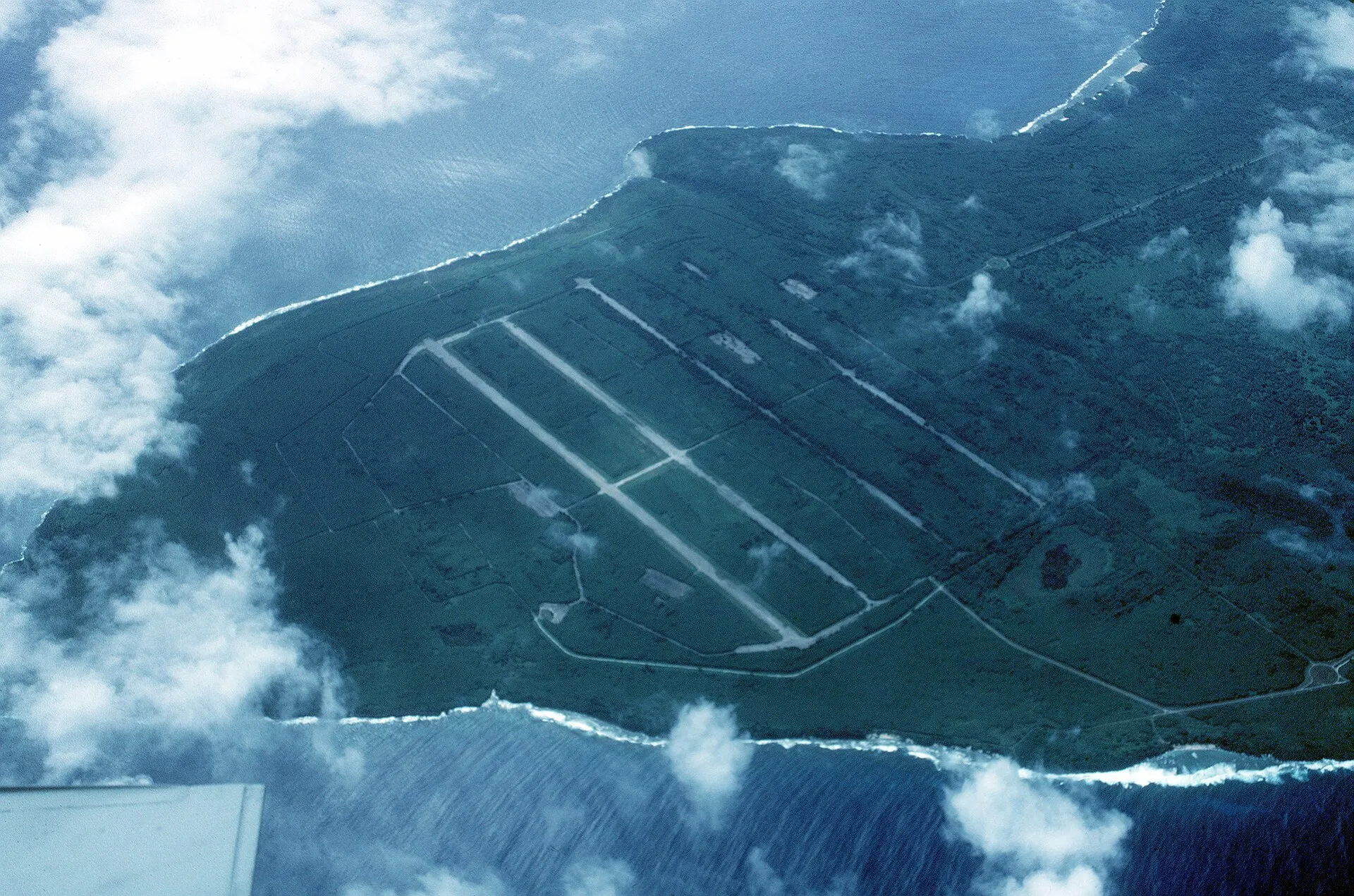

The Navy’s Seabees began repairing the Japanese airstrip at Ushi Point on 27 July 1944, while the fighting went on. About 15,000 Seabees worked on the island. Sources: 1 5 6
North Field had four parallel runways, each 8,500 feet long and 1,600 feet apart, with hardstands for 265 B-29s. Building them moved about 11 million cubic yards of coral. Sources: 1 6
The first B-29 landed at North Field on 22 December 1944. The 313th Bombardment Wing flew from North Field, and the 58th from West Field on the other side of the island. Sources: 1 4 6
Tinian’s shape reminded the builders of Manhattan, so they named its roads after New York streets: Broadway, Eighth Avenue, 42nd Street, Riverside Drive. Many of the names are still in use. Sources: 1 6 16
The 509th and Project Alberta
The 509th Composite Group began arriving at North Field in May 1945. It lived in a former Seabee camp, and its technical area and loading apron lay north of Runway Able, set apart from the rest of the airfield. Sources: 1 2 7
From April 1945 the Seabees built three air-conditioned buildings to assemble the bombs, four more for the fusing, detonator, pit and observation teams, seven warehouse-type buildings and ten magazines. Fifty-one people from Project Alberta came out from Los Alamos to do the work. Sources: 2 3 17 18
Little Boy was prepared in Assembly Building No. 1 and Fat Man in Assembly Building No. 2. Sources: 19 20
The 509th’s aircraft were kept in a guarded corner of the base, and access was tightly restricted. The group flew few raids, and the other airmen on Tinian mocked it, even stoning its camp. Sources: 7 11
The loading pits
The bombs were too large to wheel under a B-29, so two pits with hydraulic lifts were dug on the 509th’s apron. A third was built on Iwo Jima, in case a bomber had to land there. Sources: 2 3 7
Each bomb was towed to a pit on a trailer and lowered in on the lift. The B-29 was edged backwards over the pit, and the bomb was raised into its bomb bay. Sources: 7 19
Little Boy was loaded into Enola Gay on the afternoon of 5 August 1945, and Fat Man into Bockscar on the evening of 8 August 1945. Sources: 3 8 9 10

Then
August 1945
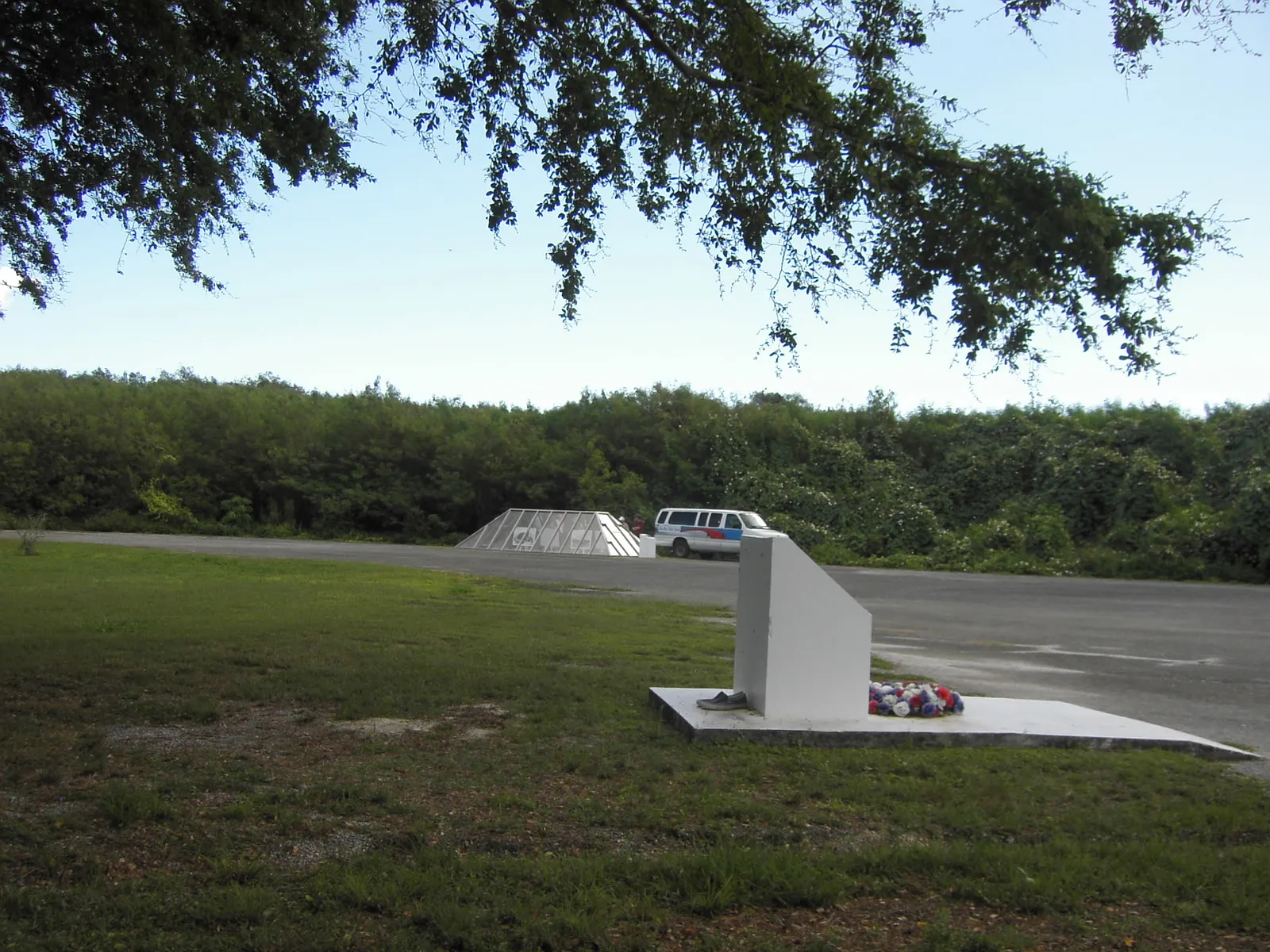
Two open pits on a guarded apron, each with a hydraulic lift, used to load the two bombs. Sources: 3 19
Now
Today
After the war the pits were filled with earth and landscaped, each with a bronze plaque. They were dug out again in the 2000s, in an effort led by Tinian’s historian Don Farrell, and now sit under glass. Sources: 1 2 7 21
The plaques name Pit No. 1 for Little Boy and Pit No. 2 for Fat Man. Other accounts, including the Marianas Visitors Authority’s, say both bombs were loaded from the same pit. Sources: 8 12
Leaving Tinian
Most of Project Alberta’s scientists and technicians left Tinian on 7 September 1945. The 509th sailed on 17 October 1945 aboard the transport Deuel, and reached Oakland on 5 November. Sources: 3 11
Tinian today
Tinian is part of the Commonwealth of the Northern Mariana Islands, a US commonwealth. Most people live in San Jose, once Tinian Town. The 2020 census counted 2,044 people on the island. Sources: 1 22 23
North Field was named a National Historic Landmark in 1985. Under a 1983 lease the US military uses the northern two thirds of the island, and North Field can close during training. Sources: 1 22
Visitors can drive Runway Able and see the glass-covered loading pits, the Japanese air operations buildings and the landing beaches. Memorials stand at the southern cliffs. Tinian is reached by a short flight from Saipan. Sources: 1 12 16 24