Part of the plane’s journey
The plane
The bombs needed an aircraft that could carry them to Japan and back. The B-29 Superfortress was the most advanced bomber of the war, and the first with pressurised crew compartments. The 509th Composite Group, formed in secret in the Utah desert, took 15 specially built Silverplate B-29s to Tinian, every one from the Martin plant at Omaha. Sources: 1 2 3 4 5 6
The Superfortress
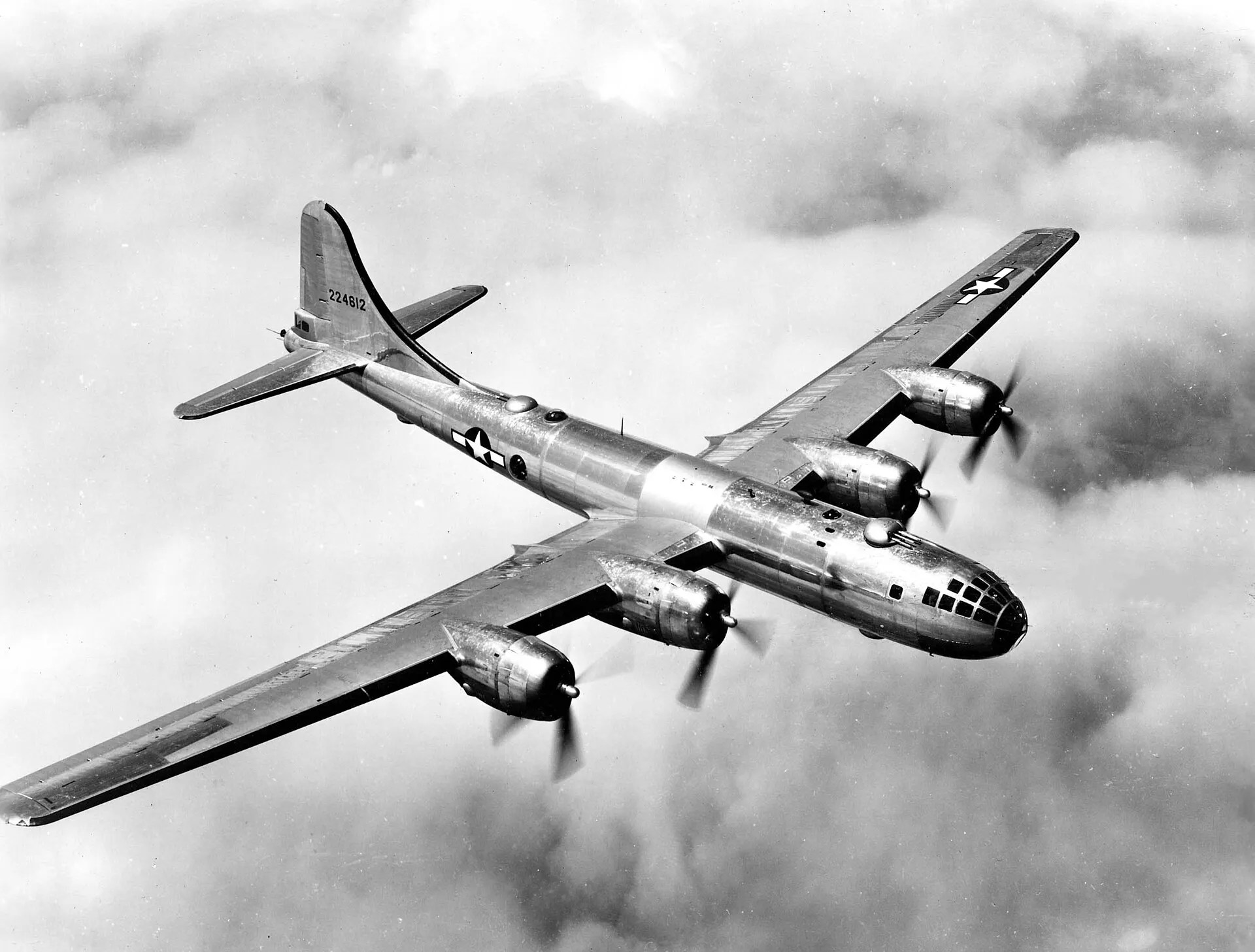

In February 1940 the US Army asked for a bomber that could carry 2,000 pounds of bombs 5,000 miles at 400 mph. Boeing’s answer was the B-29. The Army ordered it into mass production before the first prototype had flown. Sources: 1 2 7
The first XB-29 flew from Boeing Field, Seattle, on 21 September 1942, with Eddie Allen at the controls. Sources: 1 2 11
On 18 February 1943 the second prototype caught fire on a test flight and crashed into the Frye meat packing plant in Seattle. All 11 men on board died, Allen among them, with 20 workers in the plant and a firefighter. Sources: 12
Of all the bombers of the war, it was the first with pressurised crew compartments, joined by a tunnel over the bomb bays. Its guns sat in turrets aimed by remote control from sighting stations. Four Wright R-3350 engines of 2,200 horsepower drove it, and at first they overheated and caught fire. Sources: 1 2 7 13
Its wings spanned 141 feet 3 inches (43 m), and it was 99 feet (30 m) long. It could reach 357 mph (575 km/h) and carry up to 20,000 pounds (9 tonnes) of bombs. Sources: 5 14
In early 1944 the new bombers were late and full of faults. On 9 March 1944 General Hap Arnold visited Kansas and found none ready for combat. A rush of repairs in freezing weather, known as the Battle of Kansas, had about 150 ready by the middle of April. Sources: 7 15
The B-29 programme cost about 3 billion dollars, more than the Manhattan Project. Sources: 6 7 15
Building it
B-29s were built at four main plants: Boeing at Renton, Washington, and Wichita, Kansas; Bell at Marietta, Georgia; and Martin at Omaha, Nebraska. About 3,970 had been built when production ended in 1946. Sources: 1 5 16
The Glenn L. Martin plant at Fort Crook, near Omaha, first built B-26 Marauders. It went on to build 531 B-29s, more than 50 a month by late 1944, until September 1945. Fort Crook is now Offutt Air Force Base. Sources: 17 18
Into battle
The first B-29 combat mission was flown on 5 June 1944 from India, against railway yards at Bangkok. On 15 June 1944 B-29s flying from China bombed the steel works at Yawata, on Kyushu. Sources: 2 7 19
From the Mariana Islands, captured in the summer of 1944, B-29s could reach Tokyo. The first landed on Saipan on 12 October 1944, and on 24 November 1944 they made their first raid on Tokyo. Sources: 2 7
Raids from high altitude by day achieved little, so General Curtis LeMay switched to low-level night attacks with fire bombs. Sources: 20 21
On the night of 9 to 10 March 1945 about 300 B-29s attacked Tokyo. Fires destroyed about 16 square miles of the city and left about a million people homeless. Estimates of the dead range from about 80,000 to more than 100,000. Sources: 19 20 21
Silverplate
The work began in late 1943 as the Silver Plated Project, soon shortened to Silverplate. The first B-29 converted to carry a full-size bomb, serial 42-6259, reached Wright Field, Ohio, on 2 December 1943 and was finished on 20 February 1944. Sources: 6 22
Test drops at Muroc, California, began in March 1944. They showed that the bomb release had to be replaced with a British type. Sources: 6 22
On 22 August 1944 the Army ordered 17 more from the Martin plant at Omaha. A second, improved batch followed in 1945, with fuel-injected engines, reversible-pitch propellers and bomb bay doors worked by compressed air. All 15 Silverplate B-29s that the 509th took to Tinian came from Omaha. Sources: 1 5 6 22
The 509th Composite Group
Lieutenant Colonel Paul Tibbets had flown 25 missions in B-17s from England in 1942, and by 1944 he had flown the B-29 more than any other pilot. In September 1944, at Colorado Springs, he was told about the bomb and given the job of delivering it. Sources: 3 8 23
He chose Wendover Field, in the Utah desert on the Nevada state line, about 125 miles from Salt Lake City, because it was remote. Its bomber squadron, the 393rd, arrived from Fairmont, Nebraska, in September 1944. Sources: 3 24 25
The 509th Composite Group was activated on 17 December 1944. It had its own transport aircraft, engineers, ordnance men and military police: 225 officers and 1,542 enlisted men in all. Sources: 3 4 26
Secrecy was tight. Mail and telephone calls were monitored, and signs on the base read: “What you see here, what you do here, what you hear here, stays here.” Sources: 3 27
Crews practised with “pumpkins”, bombs the size and shape of Fat Man, most of them filled with concrete. The aim was to land within 200 feet of the target from 30,000 feet. In January 1945 crews went to Batista Field, Cuba, to practise long flights over the sea. Sources: 3 4 28
To Tinian
The ground echelon left Wendover by train on 26 April 1945, sailed from Seattle in the Cape Victory on 6 May and reached Tinian on 29 May. The B-29s flew out in June. Enola Gay left on 27 June and arrived on 6 July 1945. Sources: 9 29 30
The group’s own tail marking was an arrow in a circle. Before the missions its aircraft were given the tail letters of other bomb groups, to confuse Japanese intelligence. Enola Gay carried the Circle R of the 6th Bomb Group and the number 82. Sources: 5 31 32 33
The mission aircraft
Nine of the 509th’s B-29s flew on the two missions. The large number on each card is the one painted on the aircraft in August 1945. Sources: 34
-
Enola Gay
Victor number 82
Serial 44-86292
- 6 August
- Strike aircraft, carried Little Boy
- 9 August
- Weather over Kokura
-
Bockscar
Victor number 77
Serial 44-27297
- 6 August
- Not on this mission
- 9 August
- Strike aircraft, carried Fat Man
-
The Great Artiste
Victor number 89
Serial 44-27353
- 6 August
- Blast instruments
- 9 August
- Blast instruments
-
Necessary Evil
Victor number 91
Serial 44-86291
- 6 August
- Camera
- 9 August
- Not on this mission
-
Big Stink
Victor number 90
Serial 44-27354
- 6 August
- Spare, waited on Iwo Jima
- 9 August
- Camera
-
Straight Flush
Victor number 85
Serial 44-27301
- 6 August
- Weather over Hiroshima
- 9 August
- Not on this mission
-
Jabit III
Victor number 71
Serial 44-27303
- 6 August
- Weather over Kokura
- 9 August
- Not on this mission
-
Full House
Victor number 83
Serial 44-27298
- 6 August
- Weather over Nagasaki
- 9 August
- Spare, waited on Iwo Jima
-
Laggin’ Dragon
Victor number 95
Serial 44-86347
- 6 August
- Not on this mission
- 9 August
- Weather over Nagasaki
The Great Artiste was the only aircraft to fly over both target cities. Some official reports named it as the Nagasaki bomber. The mistake was found when an aircraft was chosen for the Air Force museum, and Bockscar was kept instead. Sources: 34 35 42
Enola Gay
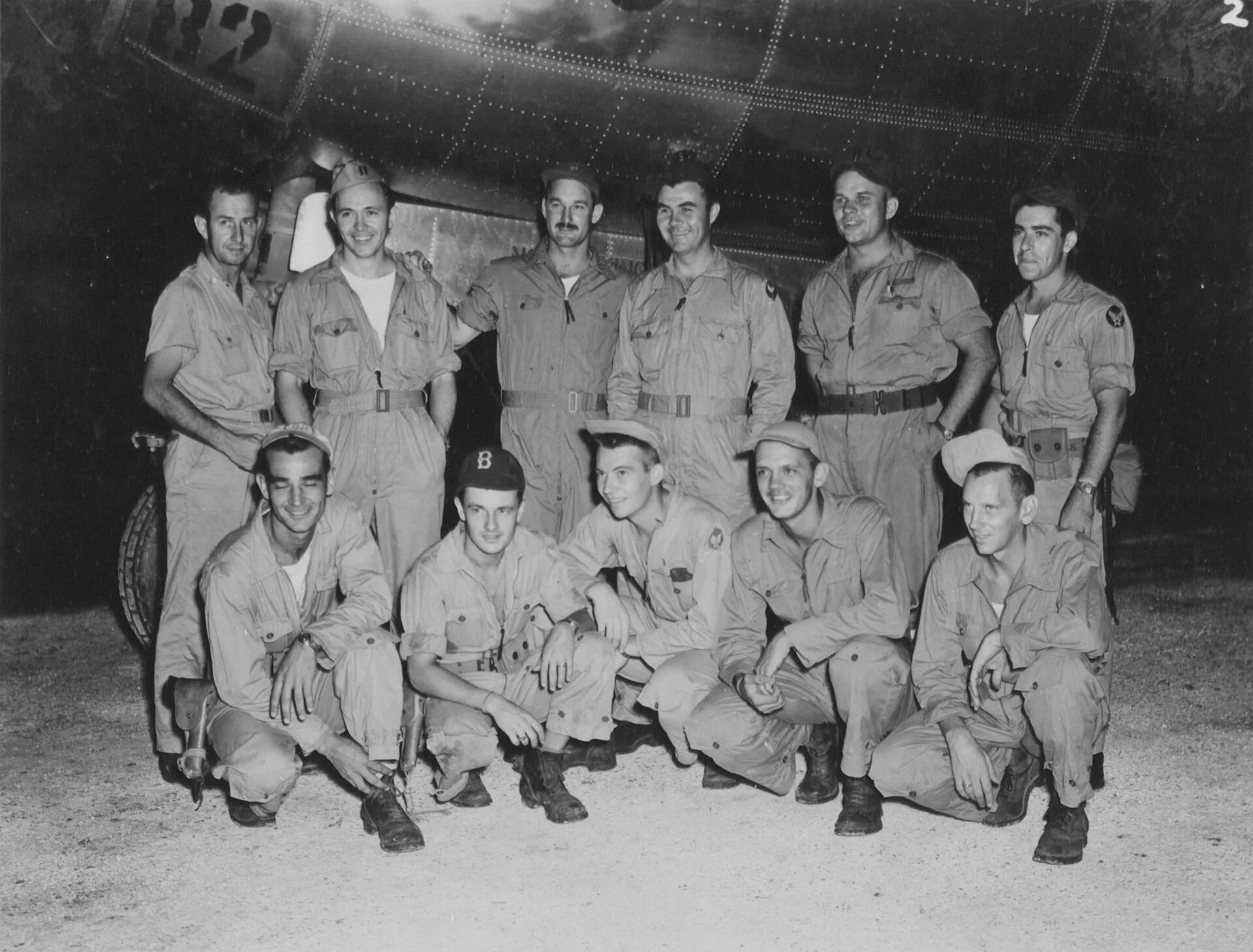

Tibbets named the aircraft after his mother, Enola Gay Tibbets. The name was painted on the day before the Hiroshima mission. Sources: 1 31
After the war it went to Kwajalein for the atomic tests of 1946, then into storage. Tibbets flew it to Chicago in July 1949, where the Smithsonian accepted it. Sources: 1 43
Restoration began in December 1984 and took about 300,000 hours of work. Sources: 1 10
In 1995 a planned exhibition about the end of the war and the bombings was cancelled after a public dispute. Only the forward fuselage went on show, from 28 June 1995 to May 1998. Sources: 44 45
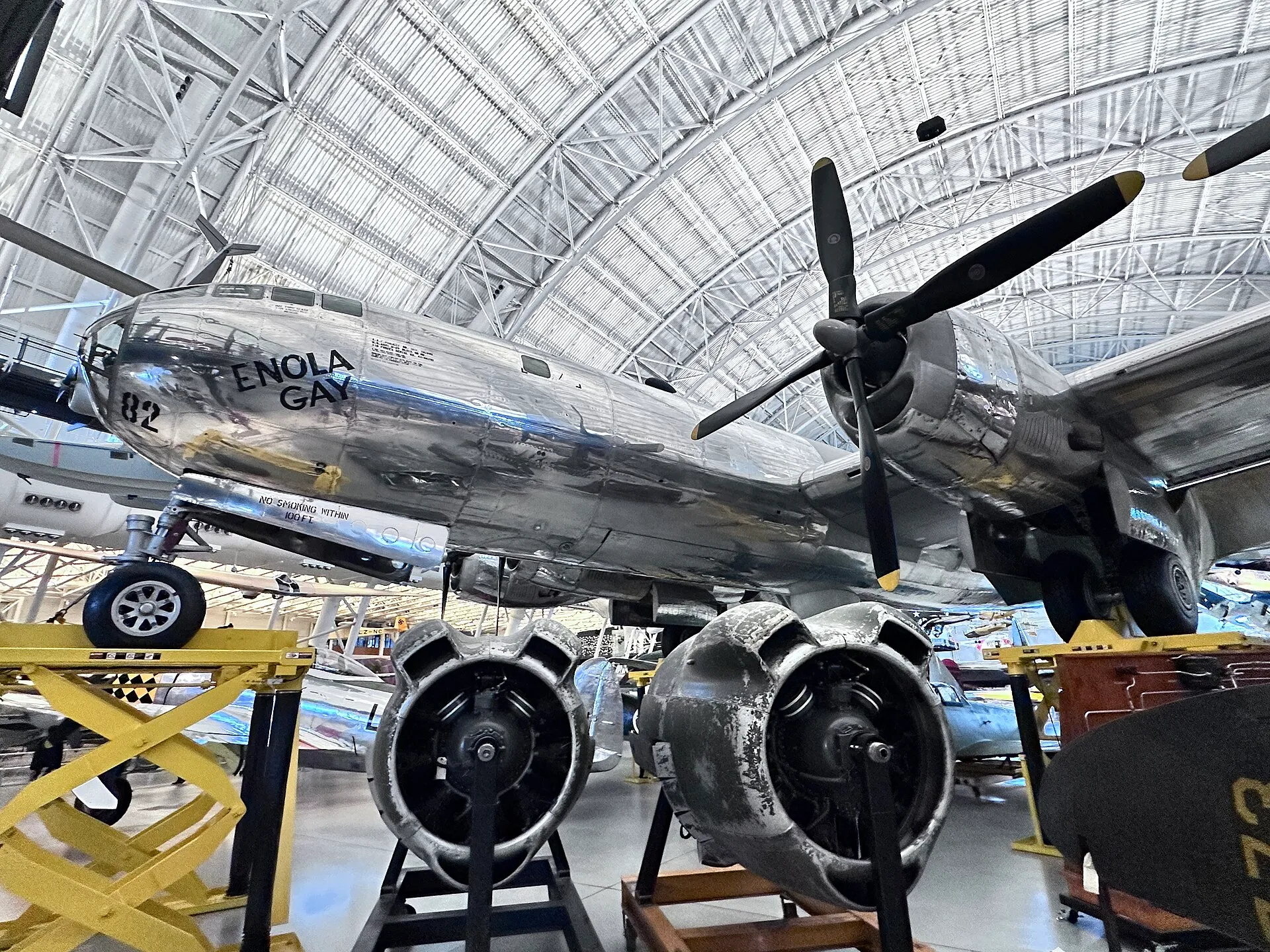

The whole aircraft has been on show at the Smithsonian’s Udvar-Hazy Center since it opened on 15 December 2003. Sources: 10
Bockscar
Bockscar was named after its usual commander, Captain Frederick Bock. For the Nagasaki mission Sweeney and Bock swapped aircraft, so that the instruments did not have to be moved out of The Great Artiste. The name was painted on after the mission. Sources: 35 42 46
It was retired to Davis-Monthan, Arizona, in September 1946 and flown to the National Museum of the US Air Force in September 1961. Sources: 35