The Los Alamos team on Tinian
Project Alberta
Fifty-one people from Los Alamos went to Tinian in the summer of 1945 to put the atomic bombs together. They were Project Alberta: scientists and engineers, Navy officers and Army technicians, the civilians among them in uniform. They assembled and tested Little Boy and Fat Man, and two of them flew with the bombs to Japan. Sources: 1 2 3 4
How it began
The work began long before it had a name. From June 1943 the Delivery Group of the Ordnance Division at Los Alamos worked out how a bomber could carry the bomb and drop it. Project Alberta, also called Project A, was set up in March 1945 to bring that work together. Sources: 1 3 5
It had three jobs: to finish designing, buying and assembling the bomb units, to carry on the test drops at Wendover, and to prepare for the operation overseas. Sources: 3
Between October 1944 and the middle of August 1945, 155 test units were dropped at Wendover, in Utah, or at Inyokern, in California. At Wendover the Little Boy gun was tested in thirty-two successful drops, and failed to fire only once. Sources: 3
In February 1945 Commander Frederick Ashworth was sent to Tinian to survey it and choose a site for the project. Sources: 3 9
The team
The people for Tinian were chosen early in May 1945. Captain William Parsons of the US Navy was in charge, with Norman Ramsey as his scientific and technical deputy and Commander Frederick Ashworth as operations officer. Sources: 1 3 10
They worked in seven teams: Fat Man assembly, Little Boy assembly, fusing, electrical detonators, the pit (the plutonium core), observation, and aircraft ordnance. Three special consultants went too: the physicist Robert Serber, the British scientist William Penney, and Captain James Nolan, an Army doctor. Sources: 1 3 11
The team leaders met as a technical committee under Ramsey. Every civilian had to wear uniform, with an Army rank to match his salary. An Army unit, the First Technical Service Detachment, housed the group and set its security rules. Sources: 3
On Tinian, decisions about the missions were taken together by Parsons, Brigadier General Thomas Farrell for the Army and Rear Admiral William Purnell for the Navy, sometimes with Colonel Paul Tibbets of the 509th. They were known as the Tinian Joint Chiefs. Sources: 1 3 12
-
Officer in charge
William S. “Deak” Parsons
Captain, US Navy 1901 to 1953
Project Alberta headquarters
- On Tinian
- Flew to Hiroshima in Enola Gay as weaponeer, and loaded the gun in flight.
- Later
- Took part in Operation Crossroads, the 1946 atomic tests at Bikini.
-
Scientific and technical deputy
Norman F. Ramsey
Civilian 1915 to 2011
Project Alberta headquarters
- On Tinian
- Chaired the committee of team leaders.
- Later
- Won the Nobel Prize in Physics in 1989.
-
Operations officer
Frederick L. Ashworth
Commander, US Navy 1912 to 2005
Project Alberta headquarters
- On Tinian
- Chose the site, then flew to Nagasaki in Bockscar as weaponeer.
- Later
- Rose to vice admiral and commanded the Sixth Fleet.
-
Team leader
Francis Birch
Commander, US Navy 1903 to 1992
Little Boy Assembly Team
- On Tinian
- Flew out with the uranium target, then supervised the assembly of Little Boy and its loading into Enola Gay on 5 August.
- Later
- A Harvard geophysicist, he received the National Medal of Science in 1967.
-
Team leader
Roger S. Warner Jr.
Civilian
Fat Man Assembly Team
- On Tinian
- Led the assembly of Fat Man.
- Later
- Headed weapon preparation for the Bikini tests in 1946.
-
Team leader
Philip Morrison
Civilian 1915 to 2005
Pit Team
- On Tinian
- Led the team for Fat Man’s plutonium core, with Charles Baker.
- Later
- Helped found the Federation of American Scientists.
-
Team member
Raemer E. Schreiber
Civilian 1910 to 1998
Pit Team
- On Tinian
- Carried Fat Man’s plutonium core out from New Mexico.
- Later
- Deputy Director of Los Alamos from 1972 to 1974.
-
Team leader
Edward B. Doll
Civilian
Fusing Team
-
Team leader
Luis W. Alvarez
Civilian 1911 to 1988
Observation Team
- On Tinian
- Flew to Hiroshima in The Great Artiste as a scientific observer.
- Later
- Won the Nobel Prize in Physics in 1968.
-
Team leader
Bernard Waldman
Civilian 1913 to 1986
Observation Team
- On Tinian
- Filmed the Hiroshima explosion from Necessary Evil, but the film could not be developed properly.
- Later
- Associate director of the National Superconducting Cyclotron Laboratory at Michigan State.
-
Team member
Harold M. Agnew
Civilian 1921 to 2013
Observation Team
- On Tinian
- Flew to Hiroshima as an observer, measuring the blast.
- Later
- Director of Los Alamos from 1970 to 1979.
-
Team member
Lawrence H. Johnston
Civilian 1918 to 2011
Observation Team
- On Tinian
- Watched both missions from The Great Artiste.
- Later
- Taught physics at the University of Idaho until he retired in 1988.
-
Team leader
Sheldon Dike
Civilian 1916 to 1984
Aircraft Ordnance Team
-
Team member
Harlow W. Russ
Civilian 1912 to 1998
Project Alberta
- On Tinian
- Helped assemble Fat Man.
- Later
- Wrote Project Alberta, a history of the team’s work.
-
Team member
Bernard J. O’Keefe
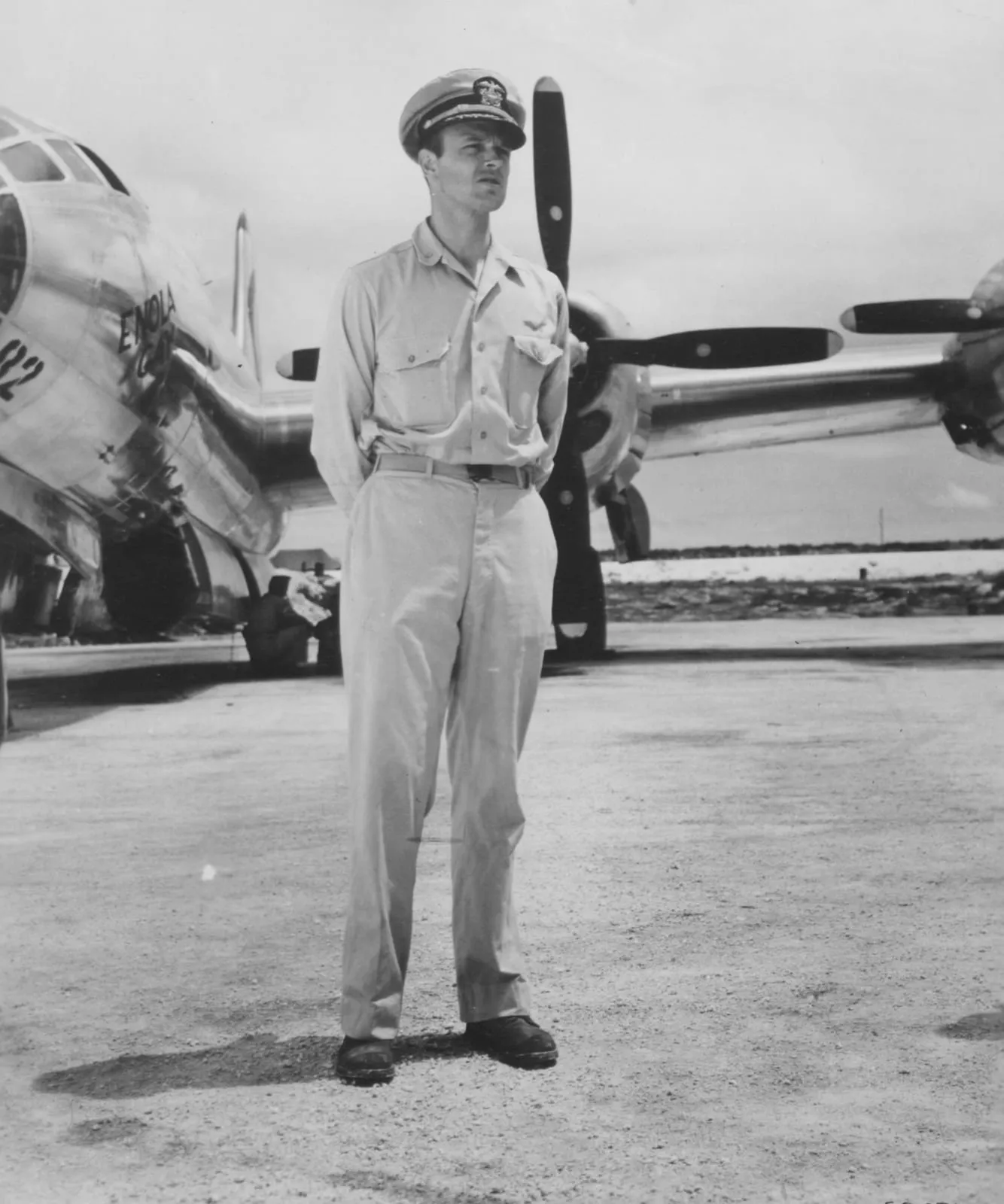
Ensign, US Navy died 1989
Project Alberta
- On Tinian
- Worked on Fat Man’s firing unit.
- Later
- Chief executive of the research company EG&G from 1965 to 1983.
-
Special consultant
Robert Serber
Civilian 1909 to 1997
Project Alberta
- Later
- Among the first Americans to enter Hiroshima and Nagasaki in September 1945; later a professor at Columbia.
-
Special consultant
William G. Penney
Civilian, British 1909 to 1991
Project Alberta
- On Tinian
- Watched the Nagasaki explosion from Big Stink.
- Later
- Led Britain’s first atomic test, Hurricane, in 1952.
-
Special consultant
James F. Nolan
Captain, US Army Medical Corps
Project Alberta
- On Tinian
- Escorted Little Boy’s parts to Tinian, landing on 26 July.
- Later
- Later researched the treatment of gynaecological cancers.
The technical area
The Seabees, the Navy’s construction battalions, put up the buildings from April 1945. The laboratory and instrument work was done in four air-conditioned Quonset huts, of the kind used to repair bombsights, in a specially guarded area. Beside them stood five warehouses, a shop and an administration building. Sources: 3
About a mile away were three air-conditioned assembly buildings, set well apart, barricaded and guarded. There were also ten magazines and two loading pits with hydraulic lifts, and a third pit was built on Iwo Jima for emergencies. Sources: 3 8
Supplies went out by sea in five batches from May. Anything urgent went in the 509th’s five C-54 transports, which the official Los Alamos history credits with letting the project beat its schedules. Sources: 2 3
Keeping in touch with Los Alamos was hard. Security rules made direct contact impossible, and the official history calls the exchange of information extremely unsatisfactory. Sources: 3
Little Boy
Little Boy came in pieces. Its uranium projectile arrived on USS Indianapolis on 26 July 1945, and the target pieces came in three transport aircraft on 28 and 29 July. Francis Birch, who led the Little Boy team, flew out with the target. Sources: 3 5 6 15
On Tinian the team dropped four Little Boy test units, all with excellent results. The last test also checked the pit on Iwo Jima, where the bomb could be moved into another aircraft in an emergency. Sources: 3
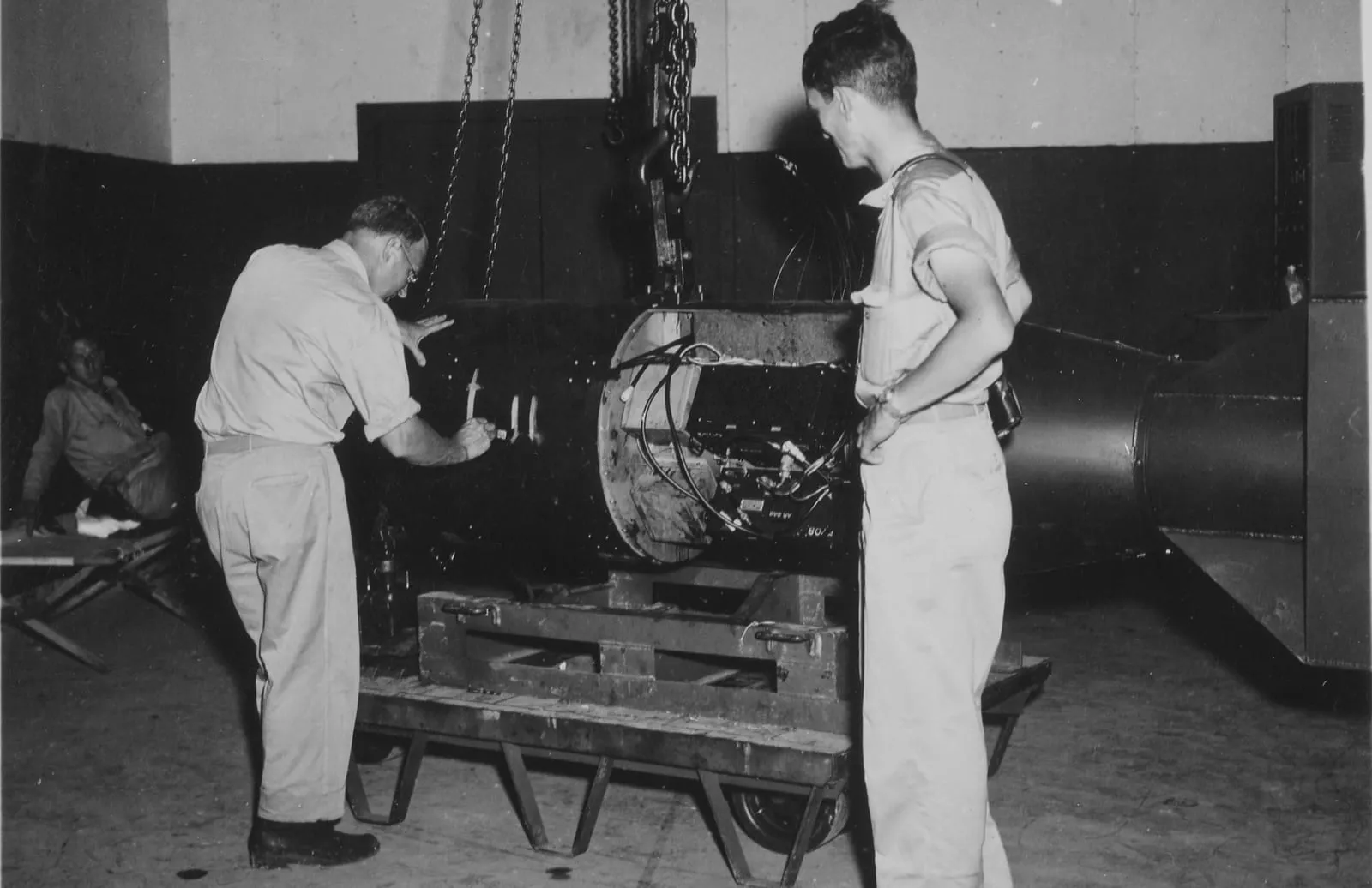
The bomb was ready by 2 August. The weather was not, and the first four days of August, in the official history’s words, were spent in impatient waiting. On the morning of 5 August the forecast for the next day was good, and Little Boy was taken to the pit and loaded into Enola Gay. Sources: 3 5 15
Only a few days before the mission, the team decided it was not safe to take off with Little Boy fully assembled. So Parsons loaded the propellant charges in flight, standing in the bomb bay, and had practised the job on the ground the day before. Sources: 3 5 7 33 34
His log gives the times: take off at 02:45, the gun loaded between 03:00 and 03:15, and the bomb dropped at 09:15 Tinian time. Sources: 3 35
Fat Man
Fat Man’s plutonium core was flown out from New Mexico by Raemer Schreiber of the pit team. It reached Tinian on 28 July. Sources: 19 20 36 37
The team dropped three Fat Man test units on Tinian, the first on 1 August. The last, on 8 August, was a full rehearsal, with a unit complete in every way except for the plutonium. Sources: 3 8
Fat Man was due to be dropped on 11 August. By 7 August the team could manage 10 August, but when Parsons and Ramsey told Tibbets, he wished it could be two days earlier: good weather was forecast for 9 August and bad weather for the five days after. The team agreed to try. Sources: 3
Before the nose cap went on, people wrote their names and messages on the casing. Sources: 38 39
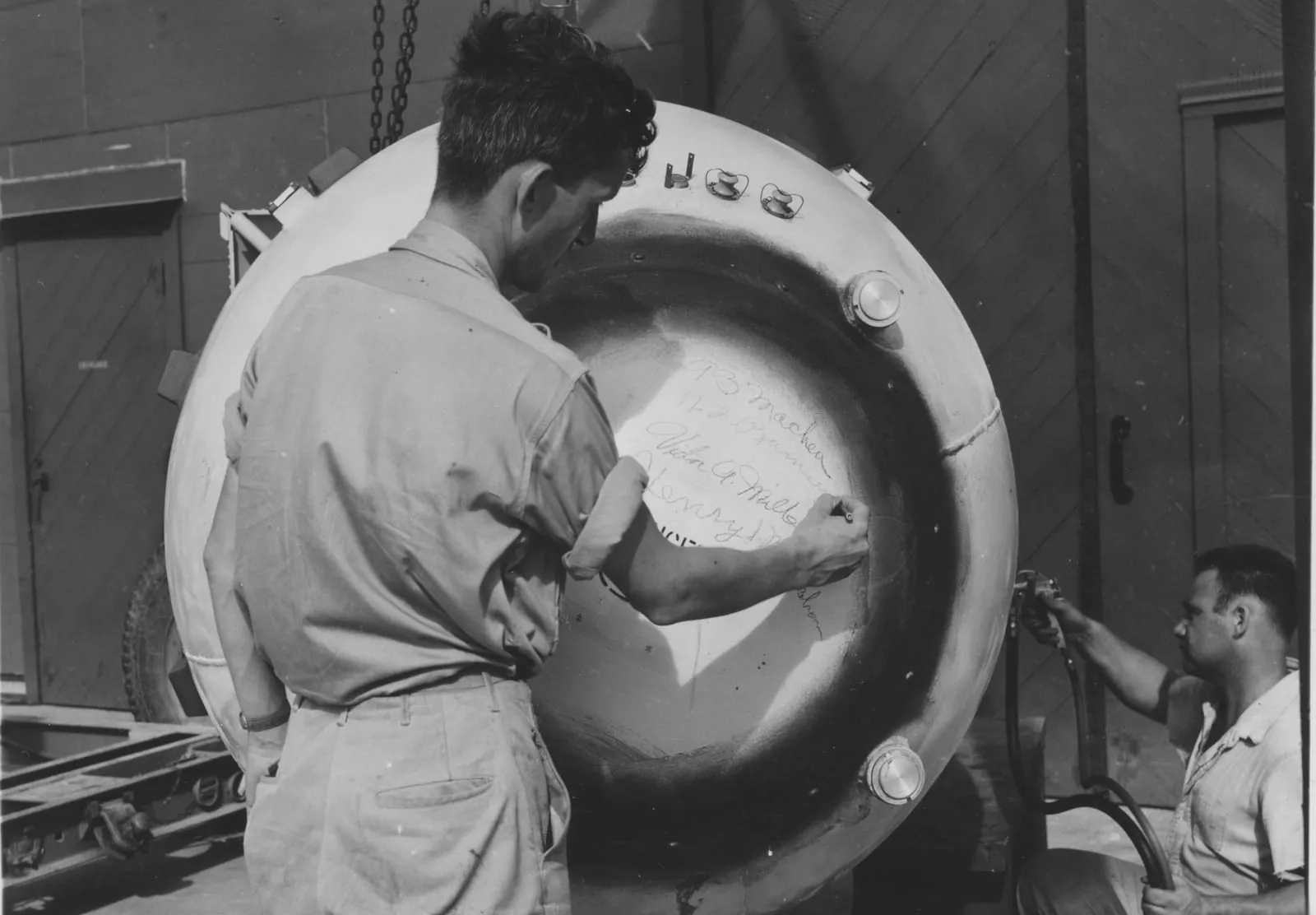
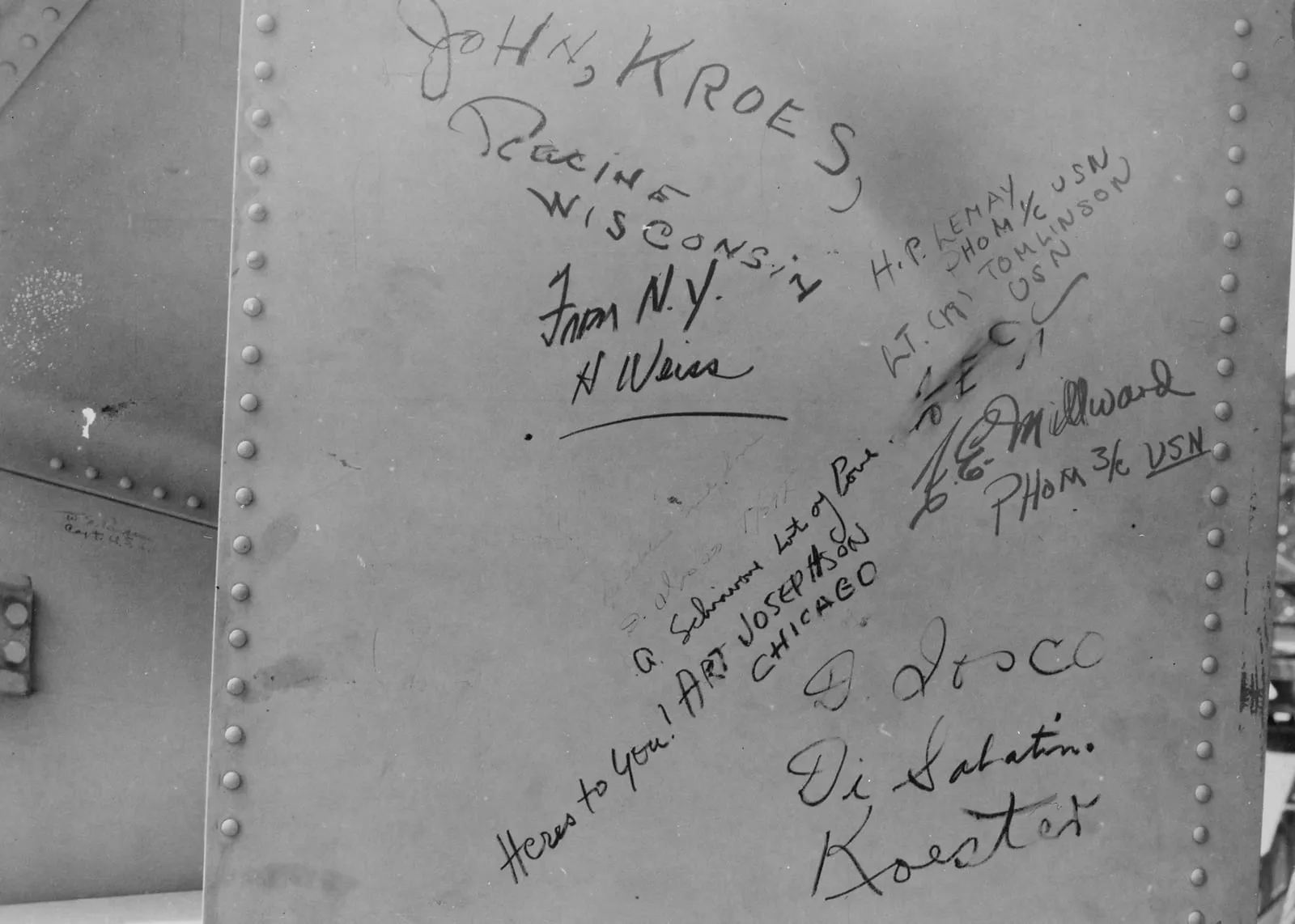
The bomb was loaded and fully checked late in the evening of 8 August. Ashworth later recalled that during that last night Bernard O’Keefe found a cable connector inside the bomb that would not fit its partner, and unsoldered and swapped the connectors himself. Sources: 3 29 37
Fat Man could not be made safe for take-off by leaving it unfinished, as Little Boy had been. The technical staff feared that a crash could scatter plutonium across Tinian, and asked for guards and an evacuation plan. The Air Force officer in command decided these were not necessary, and the take-off went without incident. Sources: 3
Afterwards
The day after Nagasaki, Japan began to negotiate its surrender, and work on further bombs stopped. The team was kept ready to assemble more in case the talks failed. Sources: 3 General Groves held back the core for a third bomb on 13 August; The bomb tells that story. Sources: 40
Some of the team went on to Japan with Farrell’s mission to study what the bombs had done. The rest of the scientists and technicians left Tinian on 7 September 1945, while Ashworth and Colonel Kirkpatrick stayed behind to dispose of the project’s property. Sources: 1 3 8
Several of them were back in the Pacific the next summer for the atomic tests at Bikini, Operation Crossroads. Parsons, Roger Warner and Raemer Schreiber all had senior parts in it. Sources: 13 17 41