1 of 8 The bomb

Part of the bomb’s journey

The bomb

Between 1942 and 1945 the United States turned a discovery in physics into a weapon. The Manhattan Project employed about 130,000 people at its peak, at more than 30 sites, and cost about 2 billion dollars. It produced two different bombs: Little Boy, which used uranium, and Fat Man, which used plutonium. Sources: 1 2 3 4 5

Why a bomb

On 2 August 1939 Albert Einstein signed a letter to President Franklin Roosevelt. The physicist Leo Szilard drafted it with him. It warned that uranium could be used to make extremely powerful bombs of a new type. Sources: 6 17

The economist Alexander Sachs, who advised Roosevelt, handed the letter over in person on 11 October 1939. On 21 October 1939 a small Advisory Committee on Uranium, chaired by Lyman Briggs, held its first meeting. Sources: 7 17 18

A British report changed the pace. In July 1941 Britain’s MAUD Committee concluded that a uranium bomb could be built, perhaps in about two years. On 9 October 1941 Roosevelt told Vannevar Bush to find out whether one could be made. Sources: 19 20 21

The Manhattan Project

The Army took charge in 1942. It set up the Manhattan Engineer District on 13 August 1942. Army engineer districts were named after the city where they began, and this one began at 270 Broadway in Manhattan. The name gave nothing away. Sources: 2 7 8 22

On 17 September 1942 Colonel Leslie Groves was put in charge of the whole project. Six days later he was promoted to brigadier general. Sources: 7 8

Three new sites did most of the work. Oak Ridge in Tennessee and Hanford in Washington made the nuclear material, and Los Alamos in New Mexico designed and built the bombs. Sources: 2 23

Chicago Pile-1

On 2 December 1942, in a squash court under the west stands of Stagg Field at the University of Chicago, a team led by Enrico Fermi achieved the first man-made, self-sustaining nuclear chain reaction. Sources: 9 10 24

The pile was a stack of about 400 tons of graphite, with about 6 tons of uranium metal and 34 to 40 tons of uranium oxide, built up in 57 layers. Sources: 9 24 25

It went critical at 15:25 local time and ran for 28 minutes at about half a watt. Forty-nine people were there to see it. Sources: 9 10 24 26

Arthur Compton telephoned James Conant with a phrase he made up on the spot: “The Italian navigator has landed in the New World.” Sources: 9 26

Early in 1943 the pile was taken apart and rebuilt, with shielding, outside Chicago as CP-2. Sources: 25

Los Alamos

The bombs themselves were to be designed at a new, secret laboratory. On 16 November 1942 Groves and J. Robert Oppenheimer chose the Los Alamos Ranch School, a boys’ school on a remote mesa in New Mexico. The Army had authority to take it by 25 November. Sources: 27 28

Oppenheimer was named the laboratory’s scientific director in February 1943 and arrived in the middle of March. The University of California signed the contract to run it on 20 April 1943. Sources: 29 30 31

Its mail went to PO Box 1663, Santa Fe. By 1945 about 6,000 people lived on the mesa. Sources: 28 32

The plateau was not empty land. Hispano families had homesteaded there since 1887, and the Army took their homesteads in late 1942. They were paid 7 to 23 dollars an acre, while the school received 225 dollars an acre. In 2004 Congress approved a 10 million dollar fund for their heirs. Sources: 33

Pueblo people, among them the people of San Ildefonso, lost access to ancestral sites on the plateau. Sources: 34

Oak Ridge: uranium
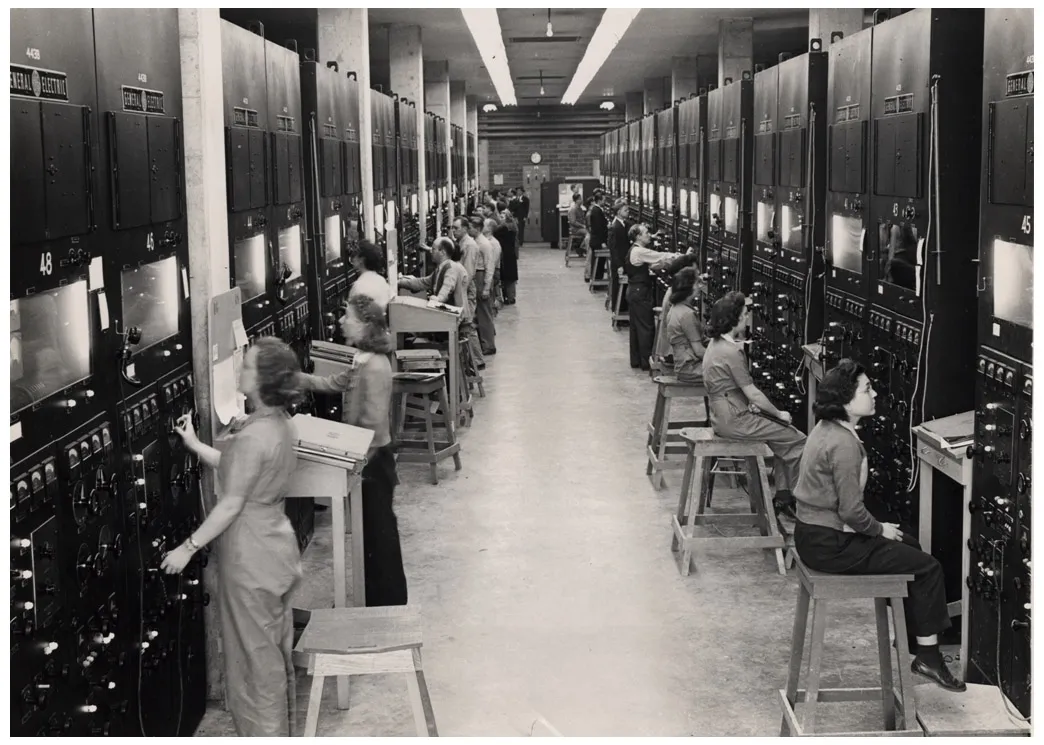
Young women seated at long rows of control panels at the Y-12 plant, Oak Ridge.
Calutron operators at Y-12, Oak Ridge. Ed Westcott, US Army, Manhattan District, Public domain (US government), source

Little Boy needed uranium rich in uranium-235, the kind that splits easily. It is chemically the same as ordinary uranium, so it has to be separated by its slightly lower weight. Sources: 35

On 19 September 1942 Groves signed the order to acquire land in east Tennessee for what became Oak Ridge. The Army took about 59,000 acres. About 1,000 families lost their homes, many with only weeks to leave. Sources: 36 37 38 39

Three plants took the uranium in stages. S-50 used heat, K-25 pumped uranium gas through barriers, and Y-12 separated it with magnets in machines called calutrons. Uranium passed from S-50 to K-25 and then to Y-12, a little richer each time. Sources: 35 40

Copper was scarce, so the magnet coils at Y-12 were wound with 14,700 tons of silver borrowed from the US Treasury. Almost all of it went back after the war. Sources: 41

K-25 was almost half a mile long. When it was built it was the largest building in the world. Sources: 40 42

About 10,000 young women from the area watched the dials of the calutrons. They were not told what they were making until 6 August 1945. Sources: 43

By 1945 about 75,000 people lived in the new town of Oak Ridge. Sources: 38 39

Hanford: plutonium

Fat Man used plutonium, an element made in nuclear reactors. On 16 January 1943 Groves approved a site on the Columbia River in Washington State. DuPont designed, built and ran the reactors and the separation plants for a fee of one dollar. Sources: 44 45 46

The site covered about 600 square miles. In March 1943 the people of Hanford, White Bluffs and Richland were told to leave, most within 30 days. Hanford and White Bluffs were cleared, and Richland became the workers’ town. Sources: 47 48

The Wanapum, Yakama, Umatilla and Nez Perce peoples lost access to the river lands. Sources: 47 48

At the peak, in mid 1944, about 50,000 people lived in the construction camp. Sources: 45 49
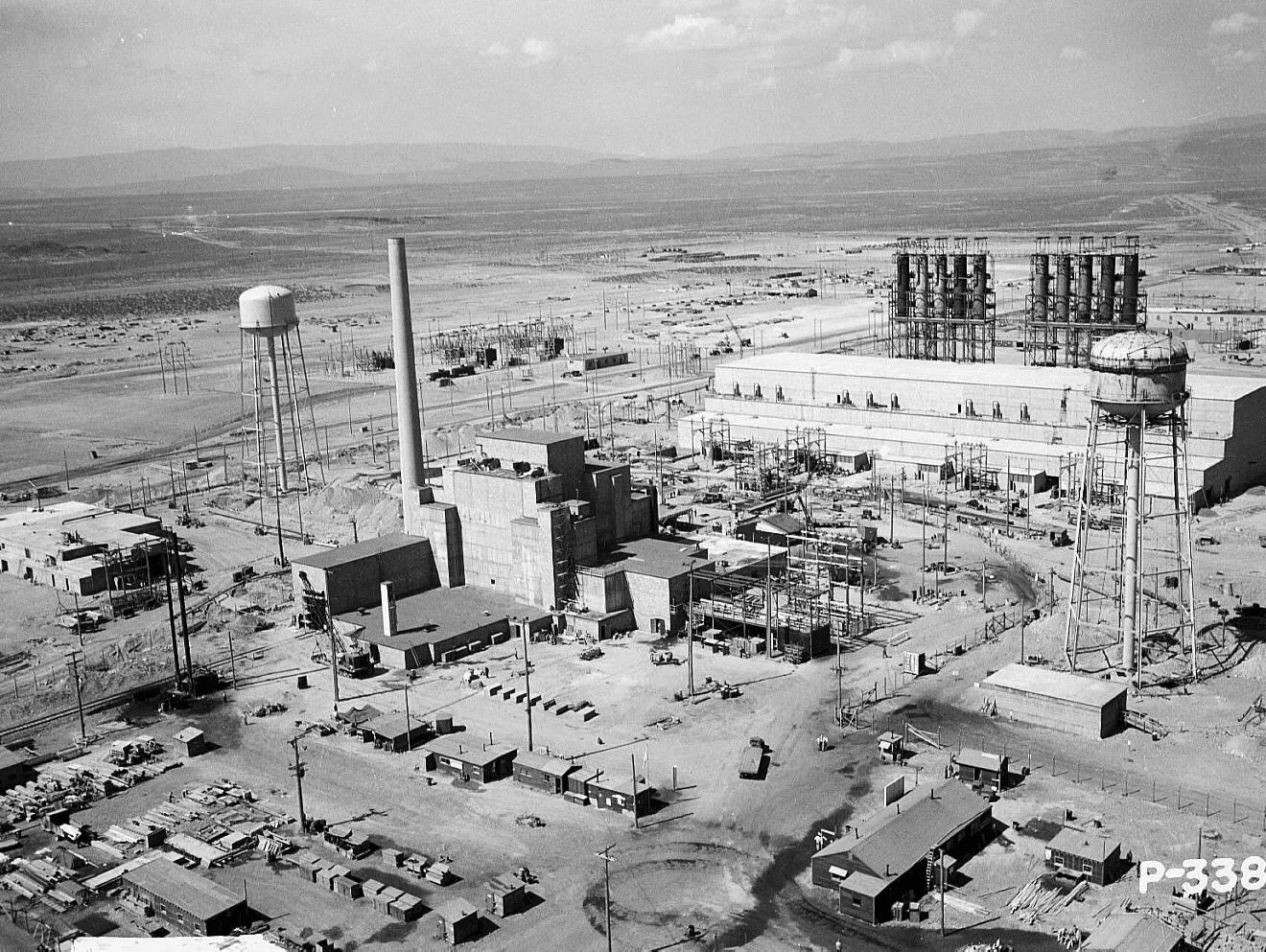
Aerial view of the B Reactor area at Hanford in 1944, with the reactor building, water towers and treatment plant.
The B Reactor area at Hanford, 1944. US Army Corps of Engineers (National Archives 7260603), Public domain (US government), source

The B Reactor first went critical on the night of 26 September 1944. Within hours the reaction faded. John Wheeler worked out that xenon-135, made by the reaction itself, was absorbing neutrons. DuPont had built the reactor with more fuel tubes than the design needed, and loading them overcame the problem. Sources: 11 12 50 51

Chemical separation began on 26 December 1944. The first Hanford plutonium reached Los Alamos on 2 February 1945. Sources: 45 49 51

A change of design

In April 1944 Los Alamos received its first plutonium made in a reactor. Emilio Segrè’s group found that it split on its own far too often, because it contained plutonium-240. In a gun design the two pieces would meet too slowly, and the bomb would fail. Sources: 52 53

On 17 July 1944 work on Thin Man, the plutonium gun, stopped. Los Alamos reorganised around implosion, squeezing a ball of plutonium with explosives fired all around it. It was a far harder problem. Sources: 53

The implosion design A sphere of explosive charges surrounds a small plutonium core at the centre. Arrows point inward from every side, showing the explosives firing together and squeezing the core. Explosive charges, fired together Plutonium core Squeezed from every side
Fat Man’s implosion design, simplified. Explosives all around a plutonium core fired at once, squeezing it from every side. Not to scale.

Trinity

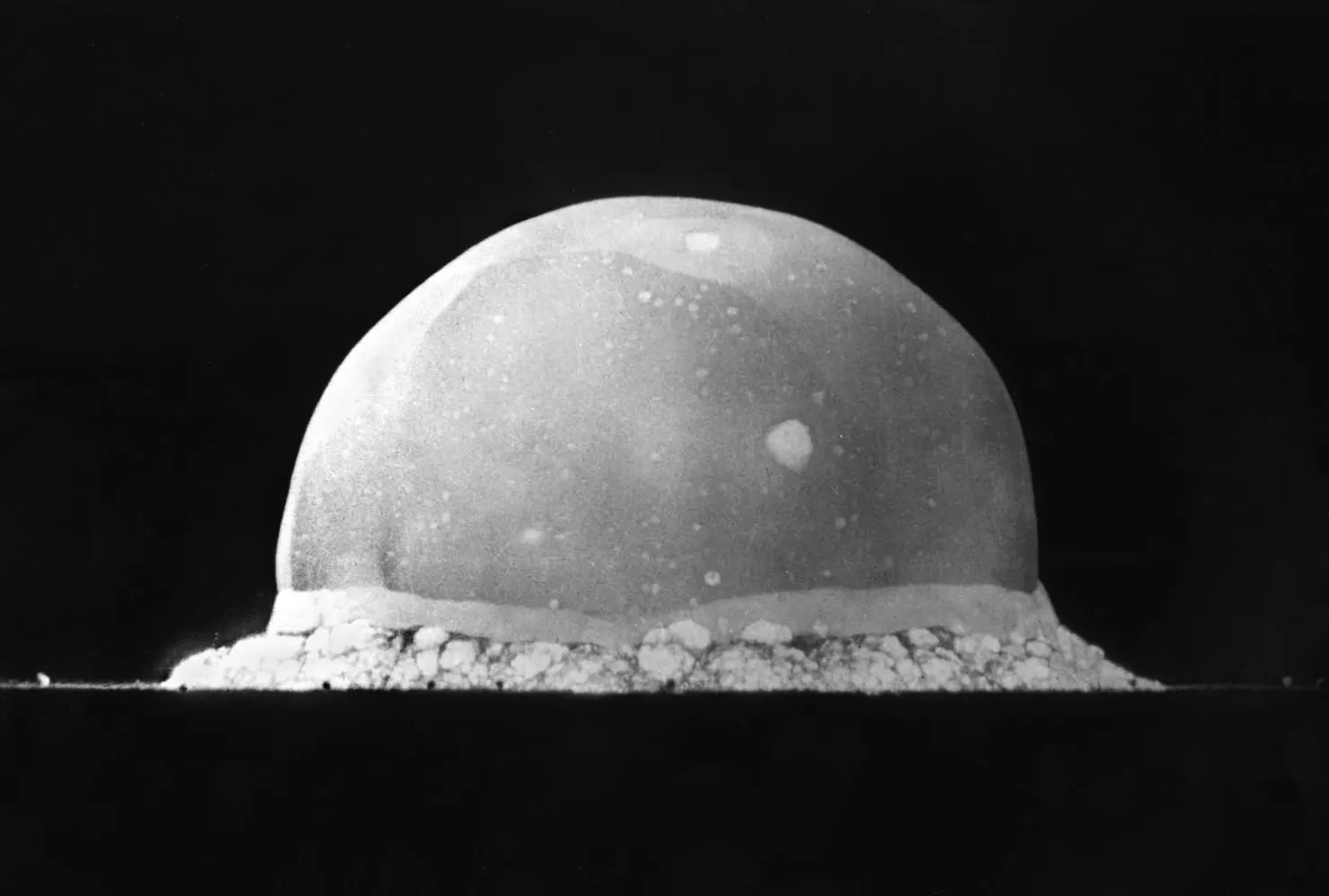
The Trinity fireball 16 milliseconds after detonation, a dome of light above the desert.
The Trinity test 16 milliseconds after detonation, 16 July 1945. Berlyn Brixner, Los Alamos National Laboratory, Public domain (US government), source

At 05:29:45 Mountain War Time on 16 July 1945 the first nuclear explosion lit the Jornada del Muerto desert in New Mexico, on land that is now White Sands Missile Range. The device, called the Gadget, sat on a 100-foot (30 m) steel tower. Sources: 13 14 54 55 56

Oppenheimer named the test Trinity. Official histories say the poetry of John Donne inspired the name. Sources: 14 55

Oppenheimer watched from the control bunker 10,000 yards south of the tower. Groves was at base camp, about 10 miles to the south-west. Sources: 14 57

A steel vessel called Jumbo, weighing 214 tons, had been built to catch the plutonium if the explosives fired but the chain reaction failed. By the time of the test the scientists were confident enough not to use it. Sources: 13 58

The heat fused the desert sand into a pale green glass, later named trinitite. Sources: 13 56

The yield has been revised as methods improved: 18.6 kilotons in 1945, 21 kilotons in 1963, and about 25 kilotons in a Los Alamos study of 2021. Sources: 59

Nobody warned the people living nearby. Fallout drifted to the north-east. In 2020 the National Cancer Institute estimated that it may have caused several hundred extra cancers, mostly of the thyroid, while stressing that the figure is very uncertain. Sources: 60 61

After decades of campaigning by the Tularosa Basin Downwinders Consortium, Congress extended radiation exposure compensation to people in New Mexico in July 2025. Sources: 60 62

Little Boy

The gun design A long barrel. At one end an explosive charge sits behind a piece of uranium, the projectile. At the other end is a second piece of uranium, the target. Firing the charge sends the projectile down the barrel into the target. Projectile Target Charge Both pieces are uranium
Little Boy’s gun design, simplified. A charge fired one piece of uranium down a barrel into another. Not to scale.

Little Boy was a gun-type bomb. A charge fired one piece of uranium down a barrel into another. It was 3.0 m long and 71 cm wide, weighed about 4,400 kg, and held about 64 kg of highly enriched uranium. Sources: 4 63 64

It was never tested before it was used. The scientists were confident in the simple gun design, and a test would have used up all the uranium-235 then made. Sources: 63 65

The bomb dropped on Hiroshima was the unit numbered L-11. Sources: 66

Only about 1.4 per cent of its uranium split. Its yield is put at about 15 kilotons, with an uncertainty of about 20 per cent. Sources: 4 64 67

Fat Man

Fat Man was an implosion bomb built around a plutonium core of about 6.2 kg. It was the same design as the Trinity device. It was 3.25 m long and 1.52 m wide, and weighed about 4,500 to 4,900 kg, depending on the source. Sources: 5 14 64 68 69 70

Its yield is put at about 21 kilotons, with an uncertainty of about 10 per cent. Sources: 5 67

The plutonium core went to Tinian by air. Teams had the bomb assembled, loaded and checked by the evening of 8 August 1945, after bad weather ahead brought the mission forward from 11 August to 9 August. Sources: 71

Project Alberta

Project Alberta, also called Project A, was set up at Los Alamos in March 1945 to prepare the bombs for use in combat. Captain William Parsons of the US Navy led it, with Norman Ramsey as his scientific deputy and Commander Frederick Ashworth in charge of operations. Fifty-one of its members went to Tinian. Sources: 15 72 73 74

The team has a page of its own: Project Alberta.

The base on Tinian was fully working by 23 July 1945. That day the team dropped its first practice Little Boy, with no nuclear material in it. The first practice Fat Man followed on 1 August. Sources: 75

The uranium projectile for Little Boy arrived on USS Indianapolis on 26 July 1945. The target pieces came in three transport aircraft on 28 and 29 July, and the bomb was ready by 2 August. The weather was not. Sources: 15 16

From the plants to Tinian Two lines. The upper line runs from Oak Ridge, Tennessee, where uranium was enriched, to Los Alamos, New Mexico, where the bomb parts were made, then by ship and aircraft to Tinian, for Little Boy. The lower line runs from Hanford, Washington, where plutonium was made, to Los Alamos, then by aircraft to Tinian, for Fat Man. OAK RIDGE LOS ALAMOS TINIAN ship, air uranium bomb parts Little Boy HANFORD LOS ALAMOS TINIAN air plutonium core, parts Fat Man
How each bomb’s nuclear material reached Tinian. Uranium for Little Boy was enriched at Oak Ridge, and plutonium for Fat Man was made at Hanford. Both went to Los Alamos, and then across the Pacific by ship and by air.

On the morning of 6 August Parsons loaded the propellant charges into Little Boy in flight, so that a crash on take-off could not set it off. Sources: 15 76

A third bomb

On 10 August Groves told the Army Chief of Staff, General George Marshall, that the next implosion bomb could be ready in the first good weather after 17 or 18 August. Marshall wrote that it was not to be used over Japan without the express authority of the President. On 13 August Groves held back its core. Sources: 77 78

On 21 August 1945 Harry Daghlian was fatally irradiated at Los Alamos while working with that core. Sources: 79

Sources for this page79
  1. US Department of Energy, Office of Legacy Management, The Manhattan Project. Checked 11 October 2026.
  2. US National Park Service, Manhattan Project National Historical Park, Learn About the Park. Checked 11 October 2026.
  3. US Department of Energy, Office of Scientific and Technical Information, Final Approval to Build the Bomb. Checked 11 October 2026.
  4. US Department of Energy, Office of Scientific and Technical Information, The Atomic Bombing of Hiroshima. Checked 11 October 2026.
  5. US Department of Energy, Office of Scientific and Technical Information, The Atomic Bombing of Nagasaki. Checked 11 October 2026.
  6. US Department of Energy, Office of Scientific and Technical Information, Einstein's Letter, 1939. Checked 11 October 2026.
  7. atomicarchive.com, from F. G. Gosling's Department of Energy history, Manhattan Project chronology. Checked 11 October 2026.
  8. US Department of Energy, Office of Scientific and Technical Information, Groves and the Manhattan Engineer District. Checked 11 October 2026.
  9. US Department of Energy, Office of Scientific and Technical Information, CP-1 Goes Critical. Checked 11 October 2026.
  10. University of Chicago News, The race for the first nuclear chain reaction. Checked 11 October 2026.
  11. US Department of Energy, The B Reactor National Historic Landmark (fact sheet). Checked 11 October 2026.
  12. US National Park Service, B Reactor. Checked 11 October 2026.
  13. US Army, White Sands Missile Range, Trinity Site History. Checked 11 October 2026.
  14. US Department of Energy, Office of Scientific and Technical Information, The Trinity Test. Checked 11 October 2026.
  15. Los Alamos National Laboratory, reproduced by the US Department of Energy, History of Project A (Norman Ramsey, 1945), in Los Alamos Science, 1983. Checked 11 October 2026.
  16. US Naval History and Heritage Command, Dictionary of American Naval Fighting Ships, Indianapolis II (CA-35). Checked 11 October 2026.
  17. Atomic Heritage Foundation, Einstein-Szilard Letter. Checked 11 October 2026.
  18. US Department of Energy, Office of Scientific and Technical Information, Early Uranium Research. Checked 11 October 2026.
  19. US Department of Energy, Office of Scientific and Technical Information, The MAUD Report, 1941. Checked 11 October 2026.
  20. Atomic Heritage Foundation, Britain's Early Input, 1940 to 1941. Checked 11 October 2026.
  21. US Department of Energy, Office of Scientific and Technical Information, A Tentative Decision to Build the Bomb. Checked 11 October 2026.
  22. Atomic Heritage Foundation, Manhattan, NY. Checked 11 October 2026.
  23. US National Park Service, Manhattan Project National Historical Park. Checked 11 October 2026.
  24. Atomic Heritage Foundation, Chicago Pile-1. Checked 11 October 2026.
  25. US Department of Energy, Office of Scientific and Technical Information, Chicago Pile-1. Checked 11 October 2026.
  26. US Atomic Energy Commission, 1946, reproduced by atomicarchive.com, The First Pile. Checked 11 October 2026.
  27. US Department of Energy, Office of Scientific and Technical Information, The Selection of Los Alamos. Checked 11 October 2026.
  28. Los Alamos Scientific Laboratory, reproduced by atomicarchive.com, Los Alamos: Beginning of an Era. Checked 11 October 2026.
  29. Atomic Heritage Foundation, Groves and Conant letter to Oppenheimer, 25 February 1943. Checked 11 October 2026.
  30. US Department of Energy, Office of Scientific and Technical Information, Establishing Los Alamos. Checked 11 October 2026.
  31. US National Park Service, Manhattan Project Science at Los Alamos. Checked 11 October 2026.
  32. US National Park Service, Manhattan Project National Historical Park, Secret Cities. Checked 11 October 2026.
  33. US National Park Service, Hispanic Homesteaders and the Los Alamos National Laboratory. Checked 11 October 2026.
  34. US National Park Service, Manhattan Project National Historical Park, Tribal Nations. Checked 11 October 2026.
  35. US National Park Service, Manhattan Project National Historical Park, Enriching Uranium. Checked 11 October 2026.
  36. US Department of Energy, Office of Scientific and Technical Information, Oak Ridge: Selection. Checked 11 October 2026.
  37. US Department of Energy, Office of Scientific and Technical Information, Oak Ridge: Acquisition. Checked 11 October 2026.
  38. Atomic Heritage Foundation, Oak Ridge, TN. Checked 11 October 2026.
  39. US National Park Service, Manhattan Project National Historical Park, About Oak Ridge. Checked 11 October 2026.
  40. US Department of Energy, Office of Scientific and Technical Information, K-25 Gaseous Diffusion Plant. Checked 11 October 2026.
  41. US Department of Energy, Office of Scientific and Technical Information, Y-12: The Silver Program. Checked 11 October 2026.
  42. US National Park Service, K-25 Gaseous Diffusion Plant. Checked 11 October 2026.
  43. US National Park Service, The Calutron Girls. Checked 11 October 2026.
  44. US Department of Energy, Office of Scientific and Technical Information, Hanford: Selection. Checked 11 October 2026.
  45. Atomic Heritage Foundation, Hanford, WA. Checked 11 October 2026.
  46. US Department of Energy, Office of Scientific and Technical Information, DuPont. Checked 11 October 2026.
  47. US National Park Service, Manhattan Project National Historical Park, About Hanford. Checked 11 October 2026.
  48. US National Park Service, Displacement at Hanford. Checked 11 October 2026.
  49. US Department of Energy, Office of Scientific and Technical Information, Hanford Engineer Works. Checked 11 October 2026.
  50. Atomic Heritage Foundation, Ranger in Your Pocket, The Control Room. Checked 11 October 2026.
  51. US Department of Energy, Office of Scientific and Technical Information, Hanford Becomes Operational. Checked 11 October 2026.
  52. Los Alamos National Laboratory, Atomic number 94. Checked 11 October 2026.
  53. US Department of Energy, Office of Scientific and Technical Information, Implosion Becomes a Necessity. Checked 11 October 2026.
  54. US Army, Trinity Site 80th Anniversary Commemoration: The Test. Checked 11 October 2026.
  55. Atomic Heritage Foundation, Trinity Test. Checked 11 October 2026.
  56. US National Park Service, Trinity Site, NM. Checked 11 October 2026.
  57. US Army, Trinity Site 80th Anniversary Commemoration: The Bunkers. Checked 11 October 2026.
  58. US Army, Trinity Site 80th Anniversary Commemoration: Jumbo. Checked 11 October 2026.
  59. Los Alamos National Laboratory, Revising Trinity. Checked 11 October 2026.
  60. US National Park Service, Trinity Test Downwinders. Checked 11 October 2026.
  61. US National Cancer Institute, Trinity nuclear test: community summary. Checked 11 October 2026.
  62. US Department of Justice, Radiation Exposure Compensation Program. Checked 11 October 2026.
  63. Los Alamos National Laboratory, A Tale of Two Bomb Designs. Checked 11 October 2026.
  64. Atomic Heritage Foundation, Little Boy and Fat Man. Checked 11 October 2026.
  65. US Department of Energy, Office of Scientific and Technical Information, Final Bomb Design. Checked 11 October 2026.
  66. US National Archives, via DocsTeach, Numbering Little Boy, unit L-11 (photograph, NAID 519395). Checked 11 October 2026.
  67. Los Alamos National Laboratory, via the US Department of Energy, Yields of the Hiroshima and Nagasaki Nuclear Explosions (LA-8819), 1985. Checked 11 October 2026.
  68. US National Park Service, The Gadget. Checked 11 October 2026.
  69. National Museum of the United States Air Force, Fat Man Atomic Bomb. Checked 11 October 2026.
  70. Hiroshima and Nagasaki National Peace Memorial Halls for the Atomic Bomb Victims, Differences between the atomic bombs. Checked 11 October 2026.
  71. US Department of Energy, Office of Scientific and Technical Information, Assembling Fat Man. Checked 11 October 2026.
  72. Atomic Heritage Foundation, Project Alberta. Checked 11 October 2026.
  73. Atomic Heritage Foundation, Norman Ramsey. Checked 11 October 2026.
  74. US National Park Service, Tinian Island during the Manhattan Project. Checked 11 October 2026.
  75. US Department of Energy, Office of Scientific and Technical Information, Tinian Island. Checked 11 October 2026.
  76. Atomic Heritage Foundation, Dangers of Accidental Detonations. Checked 11 October 2026.
  77. US National Archives, via DocsTeach, Memorandum from Groves to the Chief of Staff about another atomic bomb, 10 August 1945 (NAID 6874336). Checked 11 October 2026.
  78. George C. Marshall Foundation, Gen. Marshall and Gen. Groves, August 1945. Checked 11 October 2026.
  79. Los Alamos National Laboratory, Actinide Research Quarterly, Shining light on a dark element. Checked 11 October 2026.
Where sources differ14
  • Estimates of the cost run from 1.89 billion dollars to the end of 1945 to 2.2 billion dollars (Department of Energy). The Department of Energy history says more than 2 billion.
  • One National Park Service timeline gives 18 June 1942 for the district's founding. The Department of Energy history and its chronology give 13 August 1942.
  • The Department of Energy fact sheet and the National Park Service give the night of 26 September 1944. Other Department of Energy and Atomic Heritage Foundation pages say it was in the early hours of 27 September.
  • One National Park Service timeline says Roosevelt received the letter on 2 August 1939, the day it was written. The Atomic Heritage Foundation and the Department of Energy chronology give 11 October 1939.
  • The Department of Energy history gives 34 tons of uranium oxide; the Atomic Heritage Foundation gives about 40. Tons here are US short tons.
  • One Department of Energy page gives 15:20 and less than one watt. Another gives 15:25 and about half a watt, as do the University of Chicago and the 1946 account.
  • The University of Chicago and the Atomic Heritage Foundation give 49. One Department of Energy page says about twenty of Fermi's group watched from the balcony.
  • The Department of Energy history gives 14,700 tons; other accounts round it to almost 15,000. Tons here are US short tons.
  • The Atomic Heritage Foundation and the National Park Service give about 75,000. The Department of Energy history gives about 61,000 living there in summer 1945.
  • Published figures for the site's size run from about 400,000 to 580,000 acres, or 600 to 670 square miles.
  • The US Army and the Atomic Heritage Foundation give 5:29:45 am Mountain War Time. The Department of Energy history rounds this to 5:30 am.
  • The Army and the Atomic Heritage Foundation give 5:29:45 am. The Department of Energy history rounds it to 5:30 am.
  • The Army gives Jumbo's weight as 214 tons. The Atomic Heritage Foundation gives 200, the Department of Energy over 200, and Los Alamos 216.
  • Published weights for Fat Man range from 10,000 lb (Air Force museum) and 4.5 tonnes (Peace Memorial Halls) to 10,800 lb (Atomic Heritage Foundation).

Checked against its sources on 11 October 2026.